

Template
Free ISO 9001:2026 Transition Gap Checklist
Free ISO 9001:2026 Transition Gap Checklist An essentials checklist to get you ready for the 2026 ISO 9001 transition. Download Now We have put together
If you’ve searched for:
You’re not alone.
ISO terminology is often misunderstood, particularly by organisations exploring certification for the first time. Terms such as ISO certified, ISO accredited, UKAS accredited and recognised certification are frequently used interchangeably, despite having very different meanings.
Understanding these distinctions is important.
Choosing the wrong certification route could result in unnecessary costs, procurement challenges or a certificate that fails to meet customer expectations.
This guide explains:
ISO certification is independent confirmation that an organisation’s management system meets the requirements of an internationally recognised ISO standard, such as ISO 9001, ISO 14001, ISO 45001 or ISO 27001.
Certification is issued by an independent certification body following a successful audit.
Accreditation provides confidence that the certification body itself operates competently, consistently and impartially.
ISO stands for the International Organisation for Standardisation.
ISO is an independent international organisation responsible for developing standards that help organisations improve quality, environmental performance, health and safety, information security and many other aspects of business operations.
Importantly, ISO’s role is limited to developing standards.
ISO does not:
Instead, ISO develops the standards that organisations can choose to implement and be assessed against.
ISO standards are internationally recognised frameworks that define best-practice requirements for organisations.
They help businesses improve performance, manage risk, demonstrate credibility and build confidence with customers and stakeholders.
Some of the most widely adopted standards include:
Focused on quality, customer satisfaction, process consistency and continual improvement.
Focused on environmental responsibility, sustainability and reducing environmental impact.
Focused on protecting employees and managing workplace health and safety risks.
Focused on protecting information, managing cyber-security risks and strengthening data security.
The key point is simple:
ISO standards define the requirements organisations must meet. Certification demonstrates those requirements have been independently assessed.
ISO certification is independent verification that an organisation’s management system conforms to the requirements of a recognised ISO standard.
When a business becomes ISO certified, an independent certification body has audited its management system and confirmed it meets the requirements of the relevant standard.
Certification demonstrates to customers, suppliers, regulators and stakeholders that an organisation has implemented recognised best practices and is committed to continual improvement.
Organisations rarely pursue ISO certification simply to obtain a certificate.
Most seek certification because it helps achieve broader business objectives.
Many public and private sector organisations require suppliers to hold ISO certification.
Certification provides independent assurance that systems and controls are in place.
ISO standards encourage consistency, accountability and continual improvement.
Many procurement frameworks require recognised certification.
Management systems help organisations identify, manage and mitigate risk.
Well-implemented management systems help businesses scale more effectively.
Many organisations say they are “ISO accredited” when they actually mean they are “ISO certified”.
Technically:
Accreditation provides confidence that certification bodies operate competently, consistently and impartially.
In simple terms:
Your organisation is certified.
The certification body is accredited.
Understanding ISO certification becomes much easier when you view it as a framework of trust and oversight.
The ISO Certification Framework
| Level | Organisation | Role |
|---|---|---|
| 1 | ISO | Develops international standards such as ISO 9001, ISO 14001, ISO 45001 and ISO 27001 |
| 2 |
Global ACI |
Supports international recognition of accreditation bodies |
| 3 | National Accreditation Bodies (e.g. UKAS, ANAB, DAkkS, COFRAC, Accredia) | Accredit certification bodies |
| 4 | Certification Bodies | Audit organisations and issue ISO certificates |
| 5 | Organisations | Implement ISO standards and undergo certification audits |
| 6 | ISO Certificate | Demonstrates conformity with the requirements of the relevant ISO standard |
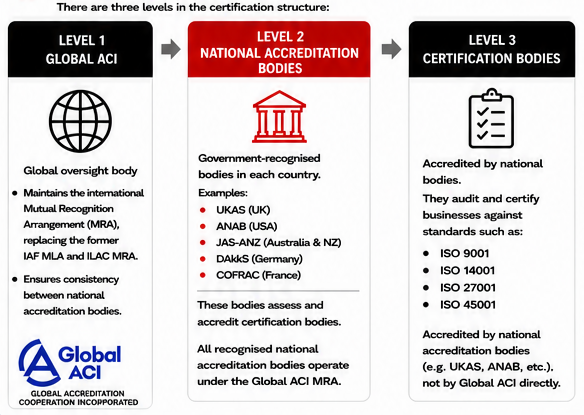
Think of it as a chain of trust: ISO develops the standards, organisations implement them, certification bodies assess organisations against those standards, accreditation bodies assess the certification bodies, and Global ACI supports international recognition of accreditation.
Who Checks Who?
| Organisation | Responsibility |
|---|---|
| ISO | Develops international standards |
Global ACI |
Supports international recognition of accreditation bodies |
| UKAS and equivalent accreditation bodies | Accredit certification bodies |
| Certification Bodies | Audit and certify organisations |
| Organisations | Implement ISO standards |
| ISO Certificate | Demonstrates conformity with a standard |
The easiest way to understand the system is:
ISO creates the standards, certification bodies assess organisations against those standards, accreditation bodies assess the certification bodies, and Global ACI supports international recognition of accreditation.
Historically, international accreditation recognition was managed through:
On the 1st January 2026, IAF and ILAC merged operationally to create the Global Accreditation Cooperation Incorporated (Global ACI).
The merger was designed to:
For most organisations pursuing ISO certification, the change does not affect day-to-day certification activities. However, it strengthens the international framework supporting confidence in accredited certification.
The United Kingdom Accreditation Service (UKAS) is the UK’s national accreditation body.
UKAS assesses certification bodies to ensure they operate:
For many buyers, procurement teams and regulators, UKAS accreditation remains an important indicator of certification credibility.
Whilst UKAS is the recognised accreditation body in the United Kingdom, most countries operate their own national accreditation bodies.
| Country | Accreditation Body |
| United Kingdom | UKAS |
| United States | ANAB, IAS |
| Germany | DAkkS |
| France | COFRAC |
| Italy | Accredia |
| Australia & New Zealand | JAS-ANZ |
| Japan | JAB |
| Canada | SCC |
These organisations participate within internationally recognised accreditation frameworks, helping support confidence and acceptance across borders.
| ISO Certification | Accreditation |
|---|---|
| Applies to organisations | Applies to certification bodies |
| Confirms conformity with an ISO standard | Confirms competence and impartiality |
| Assessed by a certification body | Assessed by an accreditation body |
| Results in an ISO certificate | Results in accreditation status |
| Demonstrates compliance to customers | Demonstrates confidence in the certification process |
Think of it this way: your business receives ISO certification, while the organisation that certifies you receives accreditation.
Accreditation is not simply an administrative detail.
It can directly affect whether a certificate is accepted by:
For many organisations, accreditation provides confidence that certification has been achieved through a recognised and robust assessment process.
Many businesses assume any ISO certificate will satisfy procurement requirements.
This is not always the case.
Acceptance often depends on:
Before investing in certification, organisations should always verify tender requirements and certification expectations.
Implementation times vary depending on organisational size and complexity.
| Organisation Size | Typical Timeline |
| 1–10 Employees | 1–3 Months |
| 10–50 Employees | 2–6 Months |
| 50–250 Employees | 3–9 Months |
| Complex Organisations | 6–12 Months |
There is no universal cost for ISO certification.
Certification costs vary depending on several factors, including:
One factor many organisations are unaware of is that certification bodies do not simply choose the number of audit days required.
For accredited certification, certification bodies are required to follow established audit duration methodologies that determine the minimum number of audit days needed. These calculations typically consider factors such as:
This helps ensure consistency across accredited certification providers and provides confidence that sufficient audit time is allocated to assess the management system effectively.
As a result, organisations may find that audit durations are similar across different certification bodies, even when quotations vary.
For this reason, businesses should focus on accreditation, recognition, value and suitability rather than selecting a certification provider solely based on price.
Before selecting a certification body, consider:
Who accredits the certification body?
Will customers and procurement teams recognise the certification?
Do they understand your sector?
Can they certify the specific standard you require?
Will they provide a consistent certification experience throughout the certification cycle?
The lowest-cost option may not provide the recognition required.
Always verify accreditation arrangements.
Certification should improve business performance, not simply generate documentation.
Implementation and certification take time.
Successful certification requires leadership commitment and employee engagement.
Before relying on an ISO certificate, organisations should carry out a few simple checks to confirm that the certification is valid, current and suitable for its intended purpose.
Check which certification body issued the certificate and confirm that it is a recognised provider operating within an accredited certification framework.
Review the accreditation arrangements supporting the certification body. In the UK, accreditation can typically be verified through recognised accreditation directories and registers.
Ensure the certificate covers the products, services, locations and activities relevant to the organisation and any contractual requirements.
Confirm that the certificate remains current and has not expired, been suspended or been withdrawn
Where certification is being used to support procurement, tender submissions or supplier approvals, always verify the specific certification and accreditation requirements set by the customer.
Where available, use official certification and accreditation verification tools to validate both the certification body and the certificate itself. This can provide additional confidence that the certification remains current and recognised.
Certification is not the end of the journey.
Organisations typically undergo:
Verifying ongoing conformity.
Monitoring system effectiveness.
Reviewing performance and improvement opportunities.
Usually every three years.
Accredited certification can provide:
For many organisations, accredited certification provides confidence throughout the supply chain.
ISO certification is independent verification that an organisation meets the requirements of a recognised ISO standard.
Accreditation applies to certification bodies and demonstrates competence and impartiality.
Not always. However, many procurement frameworks and customers prefer recognised accredited certification.
Yes. Acceptance depends on customer, contractual and regulatory expectations.
Global ACI (Global Accreditation Cooperation Incorporated) is the organisation formed following the merger of IAF and ILAC in January 2026.
Review the certification body, accreditation arrangements, scope and customer requirements.
Understanding what ISO certification is – and how accreditation supports confidence in certification – is essential for making informed business decisions.
ISO develops the standards.
Organisations implement those standards.
Certification bodies assess organisations.
Accreditation bodies assess certification bodies.
Global ACI supports international recognition of accreditation.
By understanding this framework, organisations can make informed decisions and ensure their certification investment delivers genuine value.
Whether you’re exploring ISO certification for the first time or reviewing your existing arrangements, understanding accreditation, certification and recognition requirements is essential.
Our consultants help organisations with:
Book a Discovery Call to discuss your certification goals and identify the most appropriate route for your organisation.
Get free advice and guidance tailored to your business needs
Free ISO 9001:2026 Transition Gap Checklist An essentials checklist to get you ready for the 2026 ISO 9001 transition. Download Now We have put together

Who is responsible for what? When people do not clearly understand their responsibilities, things can quickly fall through the cracks. Who approves suppliers? Who investigates
Get free advice and guidance tailored to your business needs