

Blog
ISO 9001 Clause 5.1 Explained: Leadership and Commitment Made Simple
ISO 9001 Clause 5.1 Explained: Why Leadership Owns Quality – Not the Quality Manager Many organisations proudly display signs declaring that “Quality is Our Number


If ISO 9001 Clause 4.3 defines the boundaries of your Quality Management System (QMS), then Clause 4.4 explains how the system actually operates in practice.
Clause 4.4 is one of the most important sections of ISO 9001 because it requires organisations to build a connected, process-based management system that supports effective operations, customer satisfaction, and continual improvement.
For businesses implementing ISO 9001, this is often the stage where an experienced ISO 9001 consultant can help transform the standard from a compliance exercise into a practical operational framework.
This article explains:
If you missed the earlier articles in this series, you can also read:
These clauses work together to create the foundation for your ISO 9001 management system.
ISO 9001 Clause 4.4 is titled:
Quality Management System and Its Processes
The standard requires organisations to:
“Establish, implement, maintain and continually improve a quality management system, including the processes needed and their interactions.”
In simple terms, ISO 9001 expects organisations to identify how their business processes work together to deliver consistent results.
Rather than creating isolated procedures, the standard promotes a fully connected system that reflects real business operations.
This process-based approach is central to successful ISO 9001 implementation and is a key focus area for any experienced ISO 9001 consultant supporting certification projects.
Clause 4.4 requires organisations to:
Organisations must determine the processes needed for the QMS.
Examples may include:
A skilled ISO 9001 consultant will often help organisations simplify and map these processes effectively.
Each process should clearly define:
For example:
Process | Input | Output |
Sales | Customer enquiry | Approved quotation |
Purchasing | Supplier request | Ordered materials |
Training | Competency gap | Competent employee |
Defining process inputs and outputs is a key requirement of Clause 4.4 because it improves consistency and accountability.
One of the most important requirements within ISO 9001 Clause 4.4 is determining:
“The sequence and interaction of these processes.”
This means understanding how one process feeds into another.
Many organisations demonstrate compliance with Clause 4.4 using:
Auditors will often review process interaction early during an ISO 9001 audit.
Most Quality Management Systems are structured around the Plan-Do-Check-Act (PDCA) cycle.
Plan
Define objectives, risks, resources, and processes.
Do
Carry out operational activities.
Check
Monitor performance and measure effectiveness.
Act
Implement corrective actions and improvements.
Clause 4.4 forms the operational backbone of this continual improvement model.
Clause 4.4 requires organisations to assign:
Every process should have someone accountable for:
One common issue identified by an ISO 9001 consultant during implementation is unclear ownership across departments.
Without ownership, processes often become inconsistent and ineffective.
Processes must include controls to ensure consistent operation.
Typical controls within ISO 9001 Clause 4.4 may include:
The objective is to create a Quality Management System that is controlled without becoming unnecessarily complicated.
One of the most common mistakes organisations make with ISO 9001 Clause 4.4 is over-documenting processes that add little operational value.
An effective ISO 9001 consultant will focus on creating practical systems that support operations rather than unnecessary documentation.
ISO 9001 Clause 4.4 also links directly to Clause 6.1 regarding risks and opportunities.
Organisations should identify:
Examples include:
Risk | Opportunity |
Supplier delays | Dual supplier approval |
Manual errors | Automation improvements |
Skills gaps | Enhanced training programmes |
Risk management should be integrated directly into processes under ISO 9001 Clause 4.4.
A major requirement of ISO 9001 Clause 4.4 is monitoring process effectiveness and driving continual improvement.
Typical KPIs may include:
The purpose of monitoring within ISO 9001 Clause 4.4 is not simply collecting data but improving operational performance over time.
Clause 4.4.2 requires organisations to maintain documented information necessary to support process operation.
This may include:
However, ISO 9001 does not require excessive paperwork.
Documentation should only exist “to the extent necessary”.
A practical ISO 9001 consultant will help organisations avoid overcomplicating the system.
Too many procedures create unnecessary complexity.
Disconnected departments create operational gaps.
Your documented system must match actual operations.
Processes without accountability rarely perform effectively.
Every process within ISO 9001 Clause 4.4 should support the PDCA cycle.
We’ve also created a long-form YouTube explainer series covering ISO 9001 clause by clause.
The series explains:
▶ ISO 9001 Clause-by-Clause Series
These videos are ideal for organisations implementing ISO 9001 internally or working alongside an experienced ISO 9001 consultant.
This blog concludes our review of Clause 4 – Context of the Organisation.
Next month, we’ll move into ISO 9001 Clause 5 – Leadership, where we’ll explore:
These leadership requirements are critical to building an effective Quality Management System.
ISO 9001 Clause 4.4 is where your Quality Management System becomes operational.
It creates the structure that connects organisational processes into a practical framework that supports:
When implemented effectively, Clause 4.4 helps businesses create systems that improve operational performance — not just achieve certification.
And that is exactly what a well-designed ISO 9001 management system should deliver.
Get free advice and guidance tailored to your business needs
ISO 9001 Clause 5.1 Explained: Why Leadership Owns Quality – Not the Quality Manager Many organisations proudly display signs declaring that “Quality is Our Number
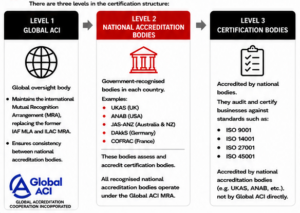
If you’ve searched for: What is ISO certification? What does ISO accredited mean? ISO certification vs accreditation UKAS accredited certification Is my ISO certificate recognised?
Get free advice and guidance tailored to your business needs