
Blog
ISO 9001 Clause 4.2 Interested Parties: A Practical Guide
If you’re implementing ISO 9001, you’ve almost certainly come across the term ISO 9001 Clause 4.2 Interested Parties. It sounds straightforward, yet in practice, many
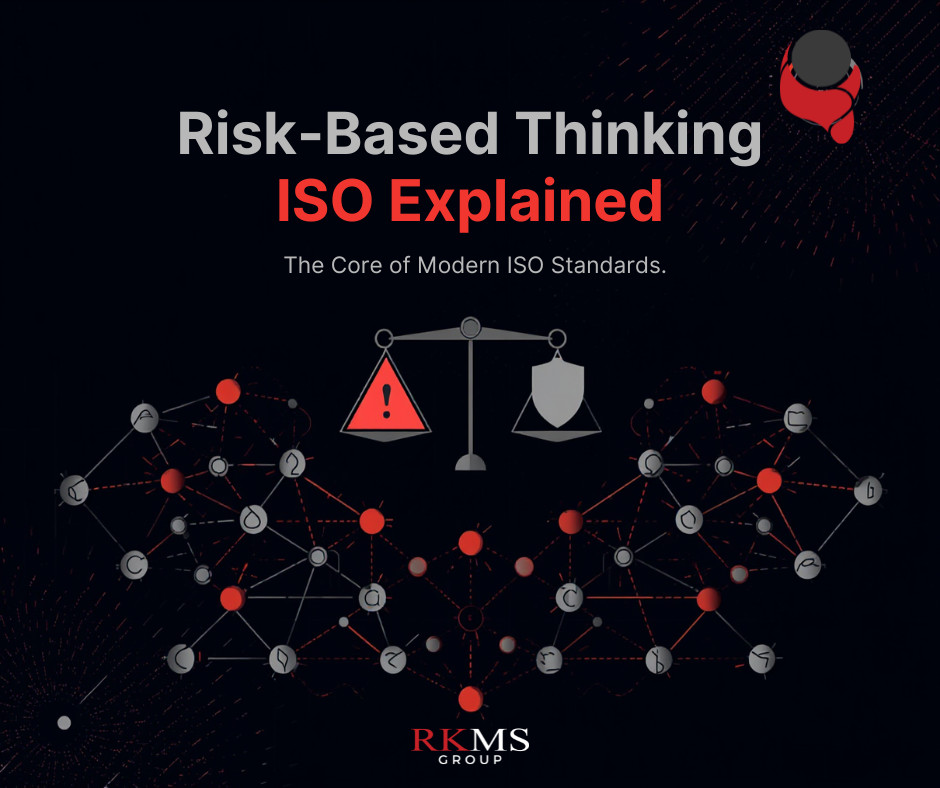
Modern businesses operate in an environment shaped by uncertainty — supply chain disruption, cyber threats, skills shortages and changing regulations. For small and medium-sized enterprises (SMEs), these uncertainties can have a disproportionate impact. This is why risk based thinking ISO principles are now central to modern ISO standards, including ISO 9001.
Rather than reacting to problems after they occur, ISO standards promote a proactive mindset: anticipating what could go wrong, understanding the potential impact, and putting sensible controls in place. Risk based thinking ISO is not about fear, paperwork or bureaucracy. It is about better planning, stronger decision-making and greater resilience.
This article explains what risk based thinking ISO really means, how it supports ISO 9001 risk management, and how SMEs can apply it in practical, everyday situations — from supplier risk to data protection and health & safety.
At its simplest, risk based thinking ISO means considering uncertainty when making decisions. ISO defines risk as the effect of uncertainty, which can be either negative (a threat) or positive (an opportunity).
Risk based thinking ISO requires organisations to:
Importantly, ISO does not require complex risk management frameworks or formal risk registers. Instead, it expects organisations to embed risk awareness into everyday processes and leadership thinking.
For SMEs, this approach is particularly valuable. It allows businesses to manage uncertainty intelligently without adding unnecessary cost or administration.
The introduction of risk based thinking ISO in ISO 9001 marked a major shift in how quality management systems operate. Earlier versions of the standard focused heavily on procedures and corrective actions. ISO 9001 now focuses on prevention rather than correction.
ISO 9001 risk management requires organisations to:
This approach aligns quality management with real business challenges. Instead of waiting for nonconformities, customer complaints or audit findings, organisations are expected to prevent problems before they occur.
For SMEs, this means ISO 9001 becomes a tool for proactive business management, not just a certification exercise.
Proactive business management is about staying in control rather than reacting under pressure. Risk based thinking ISO supports this by encouraging leaders to ask structured questions before issues arise, such as:
By asking these questions early, SMEs gain visibility over vulnerabilities and can take low-cost, high-impact actions.
Risk based thinking ISO also helps organisations identify opportunities — for example, improving a process, strengthening a supplier relationship or adopting new technology safely.
Supplier dependency is one of the most common risks facing SMEs. Many small businesses rely on a limited number of suppliers, often for cost or convenience reasons.
Rather than waiting for a supplier failure, SMEs can use risk based thinking ISO to:
This approach supports ISO 9001 risk management requirements while protecting customer delivery and reputation.
Data is essential to modern business operations, yet many SMEs underestimate the risks associated with data loss or cyber incidents.
Risk based thinking ISO encourages SMEs to ask:
These actions demonstrate proactive business management and support both ISO 9001 and wider information security expectations.
Health & safety is an area where risk based thinking ISO is often misunderstood. Many SMEs treat health & safety as a paperwork exercise rather than a preventative tool.
Instead of relying on generic risk assessments, SMEs can:
Embedding risk based thinking ISO into daily activities helps prevent harm before incidents occur and supports a positive safety culture.
Risk based thinking ISO delivers tangible benefits beyond ISO certification.
Identifying risks early reduces downtime, delays and last-minute problem solving.
Leaders make informed decisions by weighing risk alongside opportunity.
SMEs become better prepared for supply issues, staff changes and market volatility.
Consistent delivery builds trust and long-term relationships.
Auditors look for awareness and control, not paperwork. Risk based thinking ISO makes audits smoother and more meaningful.
Successful implementation does not require complex systems. Instead, SMEs should focus on leadership behaviour and consistency.
When risk based thinking ISO becomes part of how people think — not just what they document — it delivers lasting value.
Risk based thinking ISO is not about restriction or fear. It is about confidence, clarity and control in an uncertain business environment. For SMEs, it provides a practical framework for proactive business management without unnecessary complexity.
By identifying risks early, planning proportionately and reviewing regularly, organisations strengthen resilience, protect customers and support sustainable growth.
ISO 9001 risk management is not a barrier — it is a foundation for smarter, stronger businesses.
Discover how risk based thinking ISO can make your business more resilient.
Whether you are new to ISO standards or looking to strengthen your existing management system, embedding risk-based thinking is one of the most effective steps you can take.
Get free advice and guidance tailored to your business needs
If you’re implementing ISO 9001, you’ve almost certainly come across the term ISO 9001 Clause 4.2 Interested Parties. It sounds straightforward, yet in practice, many

ISO 9001 Clause 4.1 Explained: Understanding the Context of the Organisation Where ISO 9001 Clause 4.1 Actually Starts to Make Sense Before procedures.Before policies.Before internal
Get free advice and guidance tailored to your business needs