ISO 9001 Cost of Certification

ISO 9001 Certification Cost in the UK (Realistic Pricing Explained)

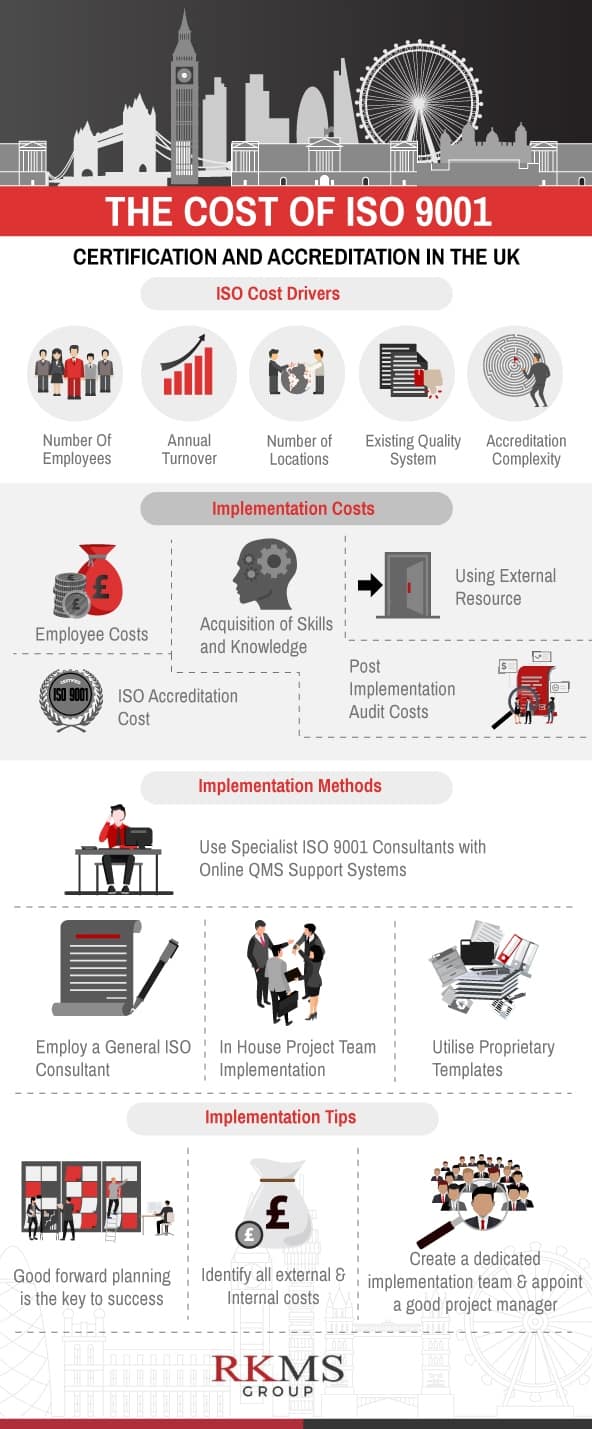
If you’re researching ISO 9001 certification cost, you’ll quickly notice that prices quoted online vary dramatically – often without explaining why.

The reality is that ISO 9001 cost in the UK depends heavily on how much of a system already exists within your business.

This guide explains the true ISO 9001 cost of certification, including:

  • When lower costs are possible
  • When higher costs are unavoidable
  • How to budget realistically and avoid misleading quotes
Iso 9001 certification cost

What Is ISO 9001 Certification?

ISO 9001 is the international standard for quality management systems (QMS). It provides a structured framework for controlling processes, improving efficiency, and consistently meeting customer requirements.

For many UK organisations, ISO 9001 certification is essential for:

  • Winning tenders and frameworks
  • Meeting supply chain requirements
  • Demonstrating operational control

Many businesses choose to work with professional ISO 9001 consultancy services
to ensure their quality management system is implemented correctly, reflects how the business actually operates, and is ready for UKAS-accredited certification audits.

ISO 9001 cost of certification

How Much Does ISO 9001 Certification Cost in the UK?

Realistic ISO 9001 Cost Ranges (UK)

ScenarioTypical Cost
ISO 9001 built from scratch£6,700 – £11,000+
Existing processes already in place£5,200 – £8,000
Highly organised, low-risk business (rare)From £3,250

👉 Most UK businesses should realistically budget £5,200+ for ISO 9001 consultancy, plus certification body fees.

This reflects the cost of doing ISO 9001 properly, not simply generating paperwork.

Why £3,250 ISO 9001 Is Possible - But Extremely Rare

It is possible to achieve ISO 9001 at around £3,250, but only where:

  • Processes are already clearly defined
  • Documentation is largely in place
  • Management commitment is strong
  • The business is low-risk and small
  • Minimal consultant input is required

These cases are exceptions, not the norm. Most organisations underestimate the time and expertise required to meet ISO 9001 requirements properly.

ISO 9001 Consultant Costs Explained

For the majority of UK organisations, ISO 9001 consultancy involves:

  • Gap analysis against ISO 9001
  • Building or refining a compliant QMS
  • Aligning documentation to real processes
  • Internal audit support
  • Management review support
  • Preparation for UKAS certification audits

Because of the time, expertise, and level of involvement required, this depth of support usually places ISO 9001 consultant costs at £5,200 or more for most businesses. Working with an experienced ISO 9001 consultant in the UK
helps ensure the system is robust, audit-ready, and tailored to your organisation rather than a generic, template-based solution.

UKAS Certification Body Costs (Minimum £1,500)

Regardless of how prepared you are, UKAS-accredited certification bodies charge their own fees.

Typical costs are:

  • From £1,500 for very small, low-risk businesses
  • £2,000–£3,000+ for SMEs and higher-risk sectors

These costs are based on:

  • Number of employees
  • Business risk category
  • Audit time required

Total ISO 9001 Cost of Certification (Year One)

When consultancy and certification are combined, realistic ISO 9001 certification cost UK figures are:

  • £6,700 – £11,000+ (from-scratch implementations)
  • £5,200 – £8,000+ (where systems already exist)
  • From £3,250 (rare, highly prepared organisations)

Ongoing ISO 9001 Costs After Certification

ISO 9001 certification operates on a three-year cycle, with ongoing costs including:

  • Annual surveillance audits (£750 – £1,500 per year)
  • Internal audits and management reviews
  • Continuous improvement and system updates

These ongoing commitments should always be factored into the true ISO 9001 cost, not just the initial certification.

How to Control ISO 9001 Cost Without Cutting Corners

Controlling ISO 9001 cost doesn’t mean taking shortcuts. It means implementing the standard efficiently and in a way that genuinely supports how your organisation operates.

Key ways to manage costs include:

Many organisations choose to manage these factors by working with experienced ISO consultancy services that focus on building management systems around existing processes. This approach helps control ISO 9001 costs without cutting corners or compromising compliance.

Is ISO 9001 Worth the Cost?

For most UK businesses, ISO 9001 certification delivers a strong return through:

  • Improved tender success
  • Greater operational control
  • Reduced inefficiencies and errors
  • Increased customer confidence

When implemented correctly, ISO 9001 becomes a practical management tool – not just a certificate.

Get a Realistic ISO 9001 Cost for Your Business

Because no two organisations are the same, the only way to know your true ISO 9001 certification cost is through an initial assessment.

👉 Speak to an experienced ISO 9001 consultant who will assess what you already have in place and give you an honest, realistic quote.

✅ Start Here:

ISO 9001 Consultant – UK Specialists

Share

Book a Free Consultation Consultation Consultation Consultation

Get free advice and guidance tailored to your business needs

Related Resources

Book a Free Consultation Consultation Consultation Consultation

Get free advice and guidance tailored to your business needs

What is ISO 9001:2015?

What is ISO 9001:2015?

What is ISO 9001:2015?

Found yourself wondering what ISO 9001 is? Can’t quite figure out whether it’s right for your organisation? Whatever aspect of ISO 9001 you’re interested in, you’ve found the right place.

We’re going to look at the what, the why, and the history of the elusive ISO 9001.

Let’s start with the “what”.

What is ISO 9001:2015?

ISO 9001 is the international standard for any quality management system (otherwise known as a QMS). To become “ISO 9001 Certified” your business has to meet the specific criteria stated in the ISO 9001 Standard.

Organisations use it to prove to their customers that they provide reliable, high-quality products, or services and that they’re willing to continuously improve their offerings.

A More In-Depth Look at ISO 9001:2015

While there are a lot of documents in the ISO 9000 Family of Standards, the only one requiring any kind of certification is the ISO 9001.

Generally speaking, an entire company will look to gain the certificate. However, the scope of the standard can be changed by a particular department.

Currently, the version that you need to adhere to is ISO 9001:2015. Here are some useful points to note as you move on to learn even more about this standard:

  • There is no “ISO 9000 Certificate”. Only the ISO 9001 certificate exists.
  • It’s not a membership group or entity. You can’t simply sign up. Instead, your organisation will need to do the following:
        • Take steps to include the ISO 9001 quality management system in your organisation.
        • Allow a Certification Body to audit your organisation against the ISO 9001 requirements.
        • If you pass this audit, you’ll be given registration for three years. You have to re-register after that.

The ISO 9001:2015 Requirements

In ISO 9001, there are 10 clauses that your organisation’s or department’s QMS (Quality Management System) must adhere to in order to gain certification.

These sections are extremely detailed and can vary depending on the industry. However, we’ll look at the basic overview of each clause so you can gain a better understanding of the criteria.

  • Scope — Defines the scope of the current 9001 standard including a list of all requirements.
  • References — Lists the standards supported by the current 9001.
  • Terms — Defines the terms used throughout the standard.
  • Context — Relates to how your organisation determines the objectives and scope of your QMS.
  • Leadership — Refers to how leadership is responsible for communicating the quality procedures.
  • Planning— Addresses opportunities, quality objectives, changes, and risks.
  • Support — The resources required for the QMS and ensures all employees are aware of all relevant information.
  • Operation — Relates to the plan and control procedures required to meet the right standards for services/products.
  • Evaluation — To qualify for ISO 9001, your company must use your QMS to effectively monitor and analyse the QMS itself as well as the business processes.
  • Improvement — Everything pertaining to continuous improvement. 

Now you’re more aware of the ins and outs of ISO 9001, let’s take a look at its origin.

A Brief History of the ISO 9001:2015 Quality Management System

The ISO 9001 standard can be traced back to the 1950s when both the UK and US governments started implementing standards for the military. At this stage, the standard was only used for large companies supplying the military to ensure a specific quality was always met.

This led to the creation of mutual recognition within the defence industry. What was this called? The NATO AQAP and MIL-Q.

In 1979, the BS5750, a quality management system standard, was created. This proved to be incredibly successful and eventually led to the first ISO 9001 standard being passed in 1987.

Since that time, the standard has been reviewed once every 5 to 8 years, just to ensure that it still meets the current international business environment.

Who is ISO 9001:2015 for?

Essentially, ISO 9001:2015 is for any organisation that wants to give its customers proof that they can work to a consistently high standard.

Having said this, you need to make sure you follow these guidelines to be eligible:

  • A single person can’t gain certification. It must be a company that seeks qualification.
  • The size of the organisation doesn’t matter.
  • The industry doesn’t matter.
  • It is not a standard that relates to products. It doesn’t prove product quality. Instead, it’s used to control your company’s processes. 

As long as you fit these requirements, ISO 9001 is for you!

The Benefits of ISO 9001:2015

The standard has proved to be beneficial not only for your company but for your customers too. The advantages that ISO consultancy support can provide to help you gain certification are seemingly limitless so it’s wise to familiarise yourself with at least a few of them.

The Benefits of ISO 9001:2015 for your Company

We’ll start with the benefits for your company.

1. Efficiency and Revenue Increase

The standard allows you to focus on the quality of your processes and procedures to increase the end result. Your revenue will boost due to this new-found efficiency.

2. Better Record Keeping

ISO 9001 ensures all your processes are recorded from the beginning to the end. This will help you deal with complaints easily and streamline your procedures.

3. Keep Improving

Since trend analysis is a huge part of ISO 9001, you will be better able to continuously improve your company. In turn, this will give you even greater profits.

4. Boost Employee Morale

The standard allows you to focus on the quality of your processes and procedures to increase the end result. Your revenue will boost due to this new-found efficiency.

The Benefits of ISO 9001:2015 for your Customers

1. Fewer Reasons for Returns

With ISO 9001, you will be able to spot and resolve problems quickly, meaning the customer won’t ever have to know. Thus, stopping them from returning products or requesting refunds.

2. Improved Customer Relationships

The standard sets out ways for your company to increase the quality of the relationships you hold between customers or shareholders. This improves the chances of having returning customers.

Final Thoughts

It’s safe to say that ISO 9001 is an in-depth standard that can take a while to wrap your head around. You’ll have gained a great deal of understanding here but be sure to delve deeper to find out exactly how your organisation can qualify.

Do you want us to take care of your ISO 9001 journey?

At RKMS we have over 25 years worth of experience in assisting companies achieve ISO 9001 with a 100% success rate. All our consultants are IRCA lead auditors so we know exactly what the auditors want to see.

Share

Book a Free Consultation Consultation Consultation Consultation

Get free advice and guidance tailored to your business needs

Related Resources

Book a Free Consultation Consultation Consultation Consultation

Get free advice and guidance tailored to your business needs