The Human Side of ISO: Building Engagement, Accountability & Teamwork

The Human Side of ISO: Building Engagement, Accountability & Teamwork

human side of ISO

When many organisations think about ISO, they picture documentation, audits, and compliance checklists. What often gets overlooked is the human side of ISO — the way it shapes communication, strengthens accountability, and brings people together around shared goals.

ISO was never designed to be a paperwork exercise. At its core, it is a people-focused framework that helps organisations work better, more consistently, and more collaboratively. When implemented properly, ISO supports employees rather than constraining them, creating clarity without stripping away personality.

For family-run businesses and SMEs in particular, the human side of ISO can be transformative — reinforcing values, protecting culture, and empowering teams as the organisation grows.

Understanding the Human Side of ISO in Modern Organisations

The human side of ISO is about recognising that systems exist to support people, not the other way around. ISO standards provide structure, but they are intentionally flexible so they can reflect how a business genuinely operates.

Rather than forcing teams into rigid processes, ISO encourages organisations to:

  • Define clear ways of working

  • Share knowledge openly

  • Reduce reliance on individuals

  • Improve collaboration across teams

This approach is especially powerful in close-knit, family-run environments where roles often overlap and knowledge is informally shared. ISO helps capture that knowledge while keeping the business personal and people-led.

Why the Human Side of ISO Matters for Employee Engagement

Employee engagement improves when people understand their role, feel listened to, and see how their work contributes to the bigger picture. This is where the human side of ISO directly supports ISO employee engagement.

How ISO Encourages Employee Involvement

ISO standards actively promote employee participation by requiring organisations to:

  • Involve staff in defining processes

  • Identify risks and improvement opportunities collaboratively

  • Provide appropriate training and support

  • Encourage feedback at all levels

When employees help shape the systems they work within, engagement naturally increases. People are more committed to processes they recognise as their own rather than something imposed from above.

The human side of ISO shifts the mindset from being managed by systems to being supported by systems.

The Human Side of ISO and Clear Communication

Poor communication is one of the most common causes of mistakes, frustration, and inefficiency. ISO addresses this head-on by encouraging clarity, consistency, and transparency.

How the Human Side of ISO Improves Day-to-Day Communication

Through documented roles, responsibilities, and processes, ISO helps teams:

  • Understand who is responsible for what

  • Access the right information at the right time

  • Reduce misunderstandings and duplicated effort

  • Communicate changes clearly and consistently

This does not replace informal conversations — it strengthens them. The human side of ISO ensures important knowledge does not rely on memory or assumption, which becomes critical as teams grow or change.

Accountability Without Blame: A People-First Approach

Accountability is often misunderstood as fault-finding. The human side of ISO reframes accountability as clarity and ownership, not criticism.

ISO-based accountability focuses on:

  • Clearly defined responsibilities

  • Consistent expectations

  • Learning from issues rather than assigning blame

  • Improving systems instead of targeting individuals

When something goes wrong, the question becomes:

“What in the system allowed this to happen?”

Not:

“Who made the mistake?”

This approach protects morale, encourages honesty, and supports continuous improvement — all essential for a healthy workplace culture.

The Human Side of ISO in Quality Management Teamwork

Quality is not the responsibility of one department or one individual. ISO reinforces the idea that quality management teamwork is essential to sustainable success.

Embedding the Human Side of ISO into Teamwork

ISO standards encourage:

  • Cross-functional collaboration

  • Shared quality objectives

  • Management reviews that involve multiple perspectives

  • Team-based problem-solving

By breaking down silos, the human side of ISO helps departments understand how their work affects others. This leads to better cooperation, fewer handover issues, and a stronger sense of shared purpose.

In SMEs and family-run organisations, this formal recognition of teamwork often reflects existing values — ISO simply provides a framework to make them consistent and scalable.

Leadership and the Human Side of ISO

Leadership plays a critical role in bringing the human side of ISO to life. ISO expects leaders to do more than approve policies — they must actively support people and improvement.

Effective ISO leadership involves:

  • Setting clear direction

  • Providing resources and training

  • Encouraging open communication

  • Demonstrating commitment through actions

In people-led organisations, this often feels natural. ISO helps leaders translate values into everyday practice, ensuring culture remains strong even as the business grows.

The Human Side of ISO in Family-Run and SME Businesses

For family-run businesses, culture is often one of the organisation’s greatest strengths. The human side of ISO helps protect that culture rather than dilute it.

ISO supports family-run and SME businesses by:

  • Reducing reliance on key individuals

  • Capturing knowledge without bureaucracy

  • Supporting growth without losing identity

  • Creating consistency while remaining flexible

Rather than changing how people work, ISO provides reassurance that the business can continue to operate smoothly — even during change.

ISO as a Support System, Not a Paperwork Exercise

When organisations embrace the human side of ISO, systems stop being seen as administrative burdens and start becoming practical tools that support people.

A people-centric ISO system:

  • Reflects real working practices

  • Uses clear, accessible language

  • Evolves with the organisation

  • Supports learning and confidence

ISO should reduce stress, not create it — giving teams the structure they need to perform at their best.

Final Thoughts: Why the Human Side of ISO Matters

ISO is not about ticking boxes. It is about helping people do their jobs well, consistently, and confidently.

When organisations focus on the human side of ISO, they unlock:

  • Stronger employee engagement

  • Better communication

  • Clearer accountability

  • More effective teamwork

ISO becomes not just a standard to achieve, but a framework for sustainable, people-first success.

Ready to Strengthen Your Team Through ISO?

Learn how ISO can strengthen your team culture by improving communication, accountability, and engagement — while staying true to the values that make your organisation unique.

Share

Book a Free Consultation

Get free advice and guidance tailored to your exact business needs

Related Resources
Book a Free Consultation Consultation Consultation Consultation

Get free advice and guidance tailored to your business needs

Continuous Improvement That Sticks: How Lean Builds a Culture That Lasts (and Still Supports ISO Compliance)

Continuous Improvement That Sticks: How Lean Builds a Culture That Lasts (and Still Supports ISO Compliance)

Cheap ISO UK

If your previous blog explored how continuous improvement becomes a culture, this is the practical follow-on: how to make that culture stick through everyday routines. The difference between good intentions and lasting change is rarely motivation. It’s structure.

This article shows how continuous improvement becomes a daily habit through PDCA, Lean management routines, and ISO-style discipline—so progress holds long after the launch meeting, the posters, and the initial enthusiasm.

Done well, a Lean-led approach doesn’t compete with compliance. It strengthens it. You get the best of both worlds: engaged teams who improve how work flows and an organisation that can demonstrate control, consistency, and evidence when it matters.

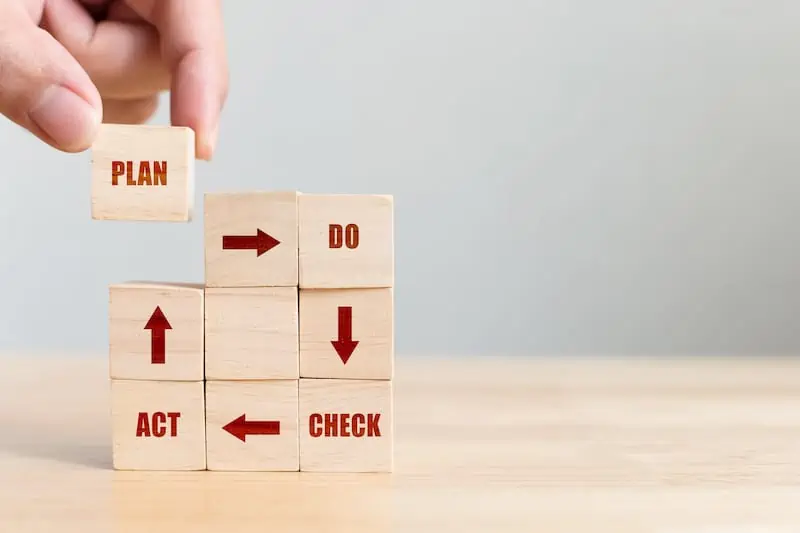
At the centre of both is a simple engine: Plan–Do–Check–Act (PDCA).

Continuous improvement culture is not a poster. It’s a routine.

Culture isn’t what’s written in a policy, a handbook, or a mission statement. Culture is what people repeat when things get busy, when priorities collide, and when mistakes happen.

A continuous improvement culture forms when teams repeatedly:

  • notice problems early,

  • fix them sensibly (not heroically),

  • learn what worked (and what didn’t),

  • and standardise improvements so they don’t disappear next week.

That rhythm is PDCA in practice—and it’s why Lean programmes feel “alive” rather than performative.

The common language: PDCA is the engine behind Lean and ISO

Lean and ISO often get framed as opposites: Lean is “practical”, ISO is “paperwork”. In reality, they can be highly complementary when you treat ISO as governance and Lean as the delivery mechanism.

PDCA is the shared language that bridges both.

Continuous improvement with PDCA in plain English

Plan: choose a problem worth solving
Not “we should improve communication”. Something you can see and measure:

  • client complaints about late updates,

  • repeat defects on the same job,

  • stockouts that cause urgent orders,

  • wasted hours searching for tools, files, or information.

Define what “better” means with one or two measures:

  • reduce rework from 18% to 10%,

  • cut tool-search time from 15 minutes per shift to 5,

  • reduce complaints from 12 per month to 6.

Do: run a small test, not a grand roll-out
Continuous improvement works fastest when you run small experiments:

  • trial a checklist for two weeks,

  • change the layout of a workspace for one shift pattern,

  • pilot a daily 10-minute huddle in one team.

Check: compare results to expectations (facts > opinions)
This is where many organisations quietly skip the work. “It feels better” isn’t a check.
Checking means:

  • did the measure move?

  • did the change create a new problem?

  • what did we learn?

Act: lock it in—or adjust and cycle again
If it worked, standardise it:

  • update the process,

  • train the team,

  • make it the new normal.

If it didn’t work, don’t hide it. Learn and run the next test.

This is why PDCA builds culture: repeating the cycle turns continuous improvement into habit, not a special event.

The Human Cost of Overcomplicated ISO Systems

Lean management programmes: shift from projects to routines

Many Lean management programmes fail for one reason: they become a collection of projects. Projects end. Culture doesn’t.

A Lean-led organisation builds routines that make continuous improvement unavoidable:

  • Daily huddles to surface issues early and assign actions fast

  • Visual management so performance is visible and abnormalities stand out

  • Standard work to create stability (you can’t improve chaos)

  • Structured problem-solving so teams fix causes, not symptoms

Lean is not “do more with less”. It’s “do less wasted work, so the same people deliver more value”.

Waste reduction isn’t ‘sacking people’—it’s continuous improvement of time, flow and productivity

Let’s tackle a common fear directly: waste reduction is not a polite way of saying redundancies.

In a healthy Lean system, waste is:

  • time spent waiting,

  • time spent fixing errors,

  • time spent hunting for information,

  • repeated approvals,

  • unnecessary movement,

  • excess inventory that ties up cash and creates confusion.

That’s not “people waste”. That’s process waste—and it costs money because time is money.

If someone is paid for eight hours but loses 90 minutes to rework, searching, waiting, and avoidable interruptions, the organisation hasn’t “saved money” by holding headcount flat. It has simply bought expensive time and then thrown a chunk of it away.

Continuous improvement is about getting the most from wages by enabling people to do productive, value-adding work:

  • fewer avoidable mistakes,

  • smoother handovers,

  • less firefighting,

better flow and less frustration.

Continuous improvement examples that remove wasted time (not jobs)

  • Searching for tools: 10 people × 10 minutes per day = 100 minutes daily. Across a year, that’s weeks of paid time spent walking and hunting rather than producing value.

  • Fixing avoidable defects: a 5-minute error can easily cost 45 minutes to correct once it moves downstream—especially when it triggers checks, approvals, and rework loops.

  • Handling client complaints: one complaint can consume multiple touchpoints—calls, emails, investigation, rework, and goodwill gestures—often far more time than doing it right first time.

  • Overstocking: you don’t just pay for stock. You pay in storage space, handling, obsolescence, counting, and the time spent searching through piles of “just in case”.

An efficient process and workspace don’t just look tidy. They return time to the team—and time is the one resource you never get back.

Where ISO fits: continuous improvement with compliance by design

Lean gives you speed and engagement. ISO-style management systems give you:

  • governance,

  • consistency,

  • traceability,

  • controlled change,

  • and a reliable way to prove you’re doing what you said you do.

The best combination is compliance by design, not compliance by inspection.

When continuous improvement is run through PDCA, you naturally create:

  • records of problems and actions,

  • checks on effectiveness,

  • updated processes where needed,

  • training/briefing evidence,

  • management review inputs (trends, risks, performance).

In other words: your improvement culture produces audit-friendly evidence as a by-product of running the organisation well—not a last-minute scramble before an external visit.

Continuous improvement and waste reduction that people can feel

Efficient processes and workspaces aren’t just “nice to have”. They directly reduce:

  • rework (less corrective action),

  • errors (fewer nonconformities),

  • client complaints (higher satisfaction and fewer escalations),

  • overstocking (less cash tied up and fewer mistakes),

  • time wasted searching for tools/files (more productivity and consistency).

If you want buy-in, lead with what people experience:

  • fewer interruptions,

  • fewer avoidable mistakes,

  • less “where’s that file/tool/part?”,

  • clearer priorities,

  • fewer last-minute panics.

That’s what makes continuous improvement stick: it improves daily life, not just dashboards.

Practical continuous improvement examples using PDCA (so it doesn’t stay abstract)

Below are realistic mini-cases you can run without turning your organisation upside down.

Example 1 — An efficient workspace reduces tool-search time and defects

Plan: Operators report frequent delays finding calibrated tools. Defects increase when “close enough” tools are used.

Do: Introduce shadow boards, labelled locations, and a simple “tool missing” escalation. Trial for two weeks on one line.

Check: Measure (a) tool-search time per shift, (b) defects linked to measurement.

Act: Standardise the layout and labels, add a quick weekly check, and make tool-control part of onboarding.

Result: less wasted time, fewer errors, and stronger control—excellent for quality and compliance.

Example 2 — A clearer process reduces rework and client complaints

Plan: Clients complain about inconsistent deliverables and late updates. Internally, teams redo work due to unclear requirements.

Do: Implement a standard intake template and a “definition of done” checklist. Pilot with one account team.
Check: Track rework rate, turnaround time, and complaint volume for four weeks.

Act: Standardise the template, train teams, and build the checklist into the workflow so it isn’t optional.

Result: fewer complaints, less rework, and an auditable trail of what was agreed and delivered.

Example 3 — Reduce overstocking without risking stockouts

Plan: Overstock ties up cash and creates confusion, yet teams still run out of critical items.

Do: Identify the top 20 fast-moving items. Introduce simple min/max levels and a visual reorder trigger (two-bin or kanban card).

Check: Measure stockouts, urgent orders, and inventory value over eight weeks.

Act: Expand to more items, standardise reorder rules, and review monthly.

Result: less waste in storage and handling, better availability, and clearer control of materials.

Example 4 — Daily management reduces firefighting (and improves accountability)

Plan: Late jobs and rushed fixes are common, but root causes are vague and ownership is blurred.

Do: Start a 10-minute daily huddle with three questions:

  1. What’s the plan today?

  2. What’s blocking us?

  3. What’s yesterday’s performance telling us?

Check: Track late jobs, escalations, and repeat issues.

Act: Standardise the huddle format and escalation rules; review weekly trends.

Result: fewer surprises, faster issue resolution, and a culture that tackles problems early.

Leadership behaviours that lock in a continuous improvement culture

Lean tools won’t save a culture that’s waiting for “the Lean person” to fix everything. Sustained continuous improvement requires leadership routines.

Leaders must:

  • ask for evidence (“What did we learn?” “Did it work?”),

  • protect time for improvement (small, regular, non-negotiable),

  • remove systemic barriers (not just chase symptoms),

  • reward standardisation as much as innovation.

Guardrails that prevent “Lean theatre”:

  • If it’s not measured, it’s not checked.

  • If it’s not standardised, it won’t stick.

  • If it’s not owned, it won’t scale.

Start small — 3 practical ways to apply continuous improvement today

  1. Run a 30-minute PDCA on one recurring annoyance
    Pick one friction point (searching, rework, waiting). Define “better” in one metric. Trial one change this week.

  2. Create one visual metric that makes problems obvious
    One board, one trend line, one agreed response when it goes off-track. Visibility turns “opinions” into action.

  3. Standardise one win
    When something works, lock it in: update the process, brief the team, and set a date to re-check in 30 days. Improvement without standardisation is just temporary luck.

Closing: the goal is a learning organisation, not a one-off programme

Lean gives you momentum. ISO-style discipline gives you consistency. Together, they create what most organisations actually want: a learning organisation that improves performance, reduces waste, and stays in control—not because someone is watching, but because it’s how work gets done.

Continuous improvement that lasts isn’t a campaign. It’s a cadence. And the best time to start is with one small PDCA cycle—this week.

Share

Book a Free Consultation Consultation Consultation Consultation

Get free advice and guidance tailored to your business needs

Related Resources

Book a Free Consultation Consultation Consultation Consultation

Get free advice and guidance tailored to your business needs
ISO Partner Checklist: How to Avoid Fake ISO Providers and Bad Advice

ISO Partner Checklist: How to Avoid Fake ISO Providers and Bad Advice

ISO Partner

ISO partner choice is not about picking the “one true” route to certification – it is about choosing something that is honest, fit for purpose and good value for your money.

For some organisations, that means going down the fully accredited route recognised under the Global Accreditation Cooperation Incorporated (GLOBAC) framework (formerly the IAF-recognised route). For others, a non-accredited certificate is entirely appropriate, particularly where customers are not asking for accredited certification and the primary goal is internal improvement or additional credibility.

There is nothing inherently wrong with non-accredited certification.

The problems arise when:

  • Providers are vague or misleading about what they are selling.

  • Businesses believe they have “the same as everyone else” when they do not.

  • Certificates are presented as something they are not — that is when we move into the territory of fake ISO providers.

This article will help you make an informed decision about your ISO partner: understanding your options, the pitfalls, and how to secure genuine value for your investment. 

Important Update: IAF Has Transitioned to GLOBAC (From 1 January 2026)

As of 1 January 2026, the International Accreditation Forum (IAF) formally ceased independent operations and merged with the International Laboratory Accreditation Cooperation (ILAC).

Together, they formed a single unified international body: Global Accreditation Cooperation Incorporated (GLOBAC).

This means:

  • The former IAF Multilateral Recognition Arrangement (MLA) now operates under GLOBAC.

  • National accreditation bodies continue their roles under the new global structure.

  • Certificates previously described as “IAF-recognised” now fall under the GLOBAC framework.

In practical terms, the system continues – but under a new global name and unified governance structure.

Many tenders and suppliers will still refer to “IAF-recognised certification” out of habit, but the correct global reference from 2026 onwards is certification recognised under the GLOBAC framework.

Importantly, accreditation bodies have not changed their core role. The oversight structure has unified globally, but accredited certification continues to operate in the same practical way. For most organisations, the impact of the 2026 transition is largely terminology rather than process.

Understanding this transition helps you interpret language used by ISO providers and avoid confusion.

Why Your ISO Partner Choice Matters (Even If You Don’t Need Accreditation)

When a customer or tender asks for “ISO 9001” or “ISO certification”, it is easy to assume all certificates are equal.

They are not.

Your choice of ISO partner determines:

  • What you are actually buying – accredited certification recognised under the GLOBAC framework, non-accredited certification, or something unclear in between.

  • Where your certificate will be accepted – limited customer acceptance or broad supply chain recognition.

  • The value you gain from the system – a genuine management tool or paperwork that sits on a shelf.

There is absolutely a place for non-accredited certification, particularly where:

  • Customers do not explicitly require accredited certification.

  • The priority is operational improvement rather than formal recognition.

  • The organisation wants a cost-effective stepping stone before moving to accredited certification later.

The key is clarity — knowing exactly what you are buying and describing it accurately.

Understanding the Landscape: Accredited vs Non-Accredited vs “Fake”

Since January 2026, global accreditation recognition operates under GLOBAC rather than IAF.

To simplify matters, there are three distinct categories.

1. Accredited Certification (Recognised Under the GLOBAC Framework)

Accredited certification is issued by certification bodies that are accredited by recognised national accreditation bodies operating under the GLOBAC global recognition framework.

These accreditation bodies oversee and verify the competence, impartiality and consistency of certification bodies. This structure ensures that accredited certificates are internationally recognised across regulated sectors, public procurement and complex supply chains.

This route makes sense when:

  • Tender documents specify certification from an accredited certification body.

  • You operate in regulated, high-risk or heavily scrutinised sectors.

  • International recognition is commercially important.

If a provider continues to use “IAF-recognised” terminology, they should be able to clearly explain how that aligns with the post-2026 GLOBAC framework.

2. Non-Accredited Certification (Legitimate but Different)

Non-accredited certification means the certification body is not accredited by a recognised national accreditation body operating under the GLOBAC framework.

This does not automatically make it invalid.

Many organisations:

  • Want structured improvement and independent assessment.

  • Have customers who only ask for “ISO certification” without specifying accreditation.

  • Prefer a more flexible or cost-effective route.

At RKMS, where a non-accredited route is genuinely appropriate, we may recommend Certa Qualitas Certification – our sister company providing independent non-accredited certification services.

The key is transparency. Non-accredited certification must be described clearly and never presented as accredited certification.

3. Fake or Misleading ISO Providers

The danger is not non-accredited certification — the danger is misrepresentation.

Be cautious if a provider:

  • Uses outdated “IAF approved” language without acknowledging the 2026 transition.

  • Claims their certificate is “equivalent to accredited certification” without explanation.

  • Uses logos resembling accreditation marks that are not genuine.

  • Suggests universal acceptance.

A credible ISO partner will clearly explain whether certification is accredited or non-accredited, and how that affects recognition.

Questions to Ask in Light of the 2026 Transition

Because of the IAF–ILAC merger, it is sensible to ask:

  • Is this certification issued by a certification body accredited by a recognised national accreditation body operating under the GLOBAC framework?

  • How does this align with the post-2026 GLOBAC structure?

  • How should we accurately describe this certification in tenders and marketing materials?

A competent provider will answer confidently and clearly.

How to Decide Which Route Is Right for You

Before choosing an ISO partner, ask yourself three practical questions.

Question 1 – What Are Your Customers Really Asking For?

Review:

  • Tender documents

  • Framework requirements

  • Key contracts

Are they asking for:

  • “ISO 9001” with no mention of accreditation?

  • “ISO 9001 certified by an accredited certification body”?

If accreditation is not specified, a non-accredited certificate may be entirely acceptable. If it is specified, accredited certification will likely be required.

Question 2 – What Is Your Primary Objective?

Be clear about your purpose:

  • Winning regulated or public sector contracts?

  • Improving operational control and consistency?

  • Strengthening credibility during growth?

If your focus is internal improvement, a well-designed non-accredited route may be appropriate. In regulated or highly scrutinised environments, accredited certification is often the safer investment.

Question 3 – What Is Your Budget and Timeframe?

A good ISO partner should:

  • Explain differences in cost and timescale between accredited and non-accredited routes.

  • Be realistic about what can be achieved within your constraints.

Help you avoid false economies.

What to Expect from a Good ISO Partner

Regardless of route, a reliable ISO partner should demonstrate:

1. Transparency

They should clearly state whether certification is accredited or non-accredited and explain what that means for recognition.

2. Practical Implementation

They should understand your business and implement systems that genuinely improve performance, not just generate documents.

3. Honest Guidance

They should explain potential limitations, future transition options and risks of misrepresentation.

Red Flags to Watch For

Be cautious if a provider:

  • Avoids clearly stating whether certification is accredited.

  • Over-promises universal acceptance.

  • Uses misleading accreditation-style branding.

  • Dismisses your questions as “technical details that don’t matter”.

Professional providers welcome scrutiny.

Common Mistakes to Avoid

Mistake 1 – Assuming Accreditation Is Always Essential

Sometimes organisations invest in accredited certification when it is not required by customers.

Mistake 2 – Assuming Accreditation Never Matters

Others choose non-accredited certification only to discover later that a key contract requires accredited certification.

Mistake 3 – Not Asking Direct Questions

Always ask:

  • What exactly are we getting?

  • Where is it likely to be accepted?

  • What are the limitations?

Clarity protects your organisation.

How RKMS Helps You Choose the Right Route

At RKMS, we support both:

  • Accredited certification routes operating under the GLOBAC framework.

  • Non-accredited certification routes where appropriate, including through Certa Qualitas Certification.

Our approach is simple:

  • Educate first.

  • Match the route to your commercial reality.

  • Protect your reputation through accurate positioning.

We focus on value, not upselling.

Free ISO Provider and Certificate Check

If you are already speaking to an ISO provider — or hold a certificate and are unsure what it represents — we can help.

Send us the details of your provider or a copy of your certificate for a free review.

We will:

  • Clarify whether it is accredited or non-accredited.

  • Highlight any potential risks.

  • Suggest practical next steps.

Your Next Step

Whether you choose accredited certification under the GLOBAC framework or a non-accredited route, the most important thing is that you:

  • Understand what you are buying.

  • Know where it will be accepted.

  • Represent it honestly.

If you would like a second opinion on a provider or proposal:

We will verify your provider for free — and help you avoid costly ISO mistakes.

Share

Book a Free Consultation Consultation Consultation Consultation

Get free advice and guidance tailored to your business needs

Related Resources

Book a Free Consultation Consultation Consultation Consultation

Get free advice and guidance tailored to your business needs

issosmart eQMS: 7 Reasons It’s the Ultimate ISO Tool for UK SMEs

issosmart eQMS: 7 Reasons It’s the Ultimate ISO Tool for UK SMEs

issosmart EQMS

For many small and medium-sized enterprises (SMEs), achieving ISO certification is a mark of quality and credibility — but maintaining it can be a challenge. Managing ISO documentation manually often means spreadsheets, version chaos, and endless admin hours.

That’s why more organisations are turning to digital solutions. And at the forefront of this change is issosmart eQMS — part of RKMS’s suite of ISO management software. Built specifically for SMEs, it simplifies compliance, automates tasks, and transforms how teams handle audits and improvement actions.

Here are seven reasons issosmart eQMS is the ultimate ISO tool for UK SMEs ready to go digital.

1. From Paper to Platform — The Digital Evolution of ISO

ISO management used to mean binders, printouts, and confusion over the “latest version” of a document. Modern standards, however, recognise digital record-keeping and remote auditing.

issosmart eQMS replaces outdated manual processes with a single cloud-based hub, giving you real-time control and visibility. Instead of chasing paperwork, you can focus on improving performance and delivering value.

Learn more about ISO standards from the International Organisation for Standardisation (ISO).

2. Designed for SMEs That Do More with Less

Unlike large corporations, SMEs often have limited time and resources. Managing ISO systems manually drains productivity and increases the risk of non-conformance.

issosmart eQMS is built for efficiency — automating reminders, centralising documents, and providing a clear audit trail. It enables small teams to achieve the same level of compliance excellence as larger organisations, without the overhead.

3. Centralised Control for Every Standard

Manage all standards from one dashboard

Whether you’re certified to ISO 9001 (Quality), ISO 14001 (Environmental), or ISO 45001 (Health & Safety), issosmart eQMS brings everything together in one system.

Documents update in real time, responsibilities are clear, and every team member works from a single source of truth. No more silos — just smooth, consistent compliance.

4. Automated Workflows That Work for You

Compliance without the chaos

From corrective actions to management reviews, automation is at the heart of issosmart eQMS. Tasks are triggered automatically, notifications go out on schedule, and approvals are tracked seamlessly.

Your team spends less time managing ISO paperwork and more time improving the business. It’s ISO management that fits around you — not the other way round.

5. Real-Time Tracking and Insight

Make data-driven compliance decisions

With issosmart eQMS, every process becomes measurable. Dashboards show trends, highlight risks, and make improvement opportunities visible.

This transparency turns audits into proactive reviews rather than stressful events. SMEs gain clarity, confidence, and control over their compliance status.

6. Real-World Results — SMEs Going Digital

One North West manufacturing SME reduced its audit preparation time by 60 % within six months of implementing issosmart eQMS. Another professional services firm cut corrective-action turnaround time in half.

These aren’t isolated results — they show how digitisation delivers tangible ROI for SMEs that embrace smarter systems.

7. Choosing the Right issosmart eQMS Software in the UK

When selecting ISO management software, alignment matters more than features alone. You need a system built for your scale, your industry, and your way of working.

UK-based EQMS providers like issosmart eQMS combine local expertise with global best practice. SMEs can start small — for example, with document control — and expand their system as their management maturity grows. It’s a partnership model designed for long-term success.

Read more about SME digital transformation in the UK Government’s Help to Grow: Digital guide.

Conclusion — Your ISO, Simplified and Digitised

Digital transformation isn’t just a trend; it’s the smarter way forward. By moving from manual systems to issosmart eQMS, SMEs can simplify ISO management, reduce risk, and build continuous improvement into their culture.

With issosmart eQMS, compliance becomes an asset — not an obstacle.

To explore tailored guidance and ISO consultancy support, contact our team today.

Request a free issosmart demo and discover how easy ISO management can be.

Share

Book a Free Consultation Consultation Consultation Consultation

Get free advice and guidance tailored to your business needs

Related Resources

Book a Free Consultation Consultation Consultation Consultation

Get free advice and guidance tailored to your business needs

Case Study: British Airways

British Airways

The Accelerate Programme

British Airways

The Accelerate Programme

Case Study Overview

Industry:

Travel / Tourism

Transport / Logistics

Service:

Lean Management

Outcome:

£20,000 identified improvements

Contacts

About British Airways

British Airways Maintenance Glasgow is a short haul major maintenance centre of excellence. Built in 1964, the facility contains two aircraft bays providing comprehensive maintenance of Boeing 737 and Airbus A320 family aircraft.

“The team at BAMG got a lot out of the LMT programme. It’s given us the tools to look at our processes and procedures and really understand where they can be improved on. We found the lean tools were excellent at breaking down and analysing very complex processes. We currently have a few other projects started, using the same tools we used on this one. Very worthwhile programme”

Lean Project

The project was to apply Lean principles to non-standard defects during the maintenance overhaul process.

The team began to process map activity, and this highlighted inefficiencies within the following areas:

  • Accumulation of data
  • Availability of tools
  • Availability of skills
  • Availability of materials / spares

Outcomes

In progressing ideas for improvement, the team created value added observation charts which demonstrated a high level of non-value-added activities due to current processing issues. This is creating a pathway to improvement as every day that aircraft maintenance runs over schedule a cost of £12,000 is incurred.

  1. All PSE information cards will be available in one area – now able to visually “scan” the cards for issues.
  2. PSE information will now be standardised eliminating duplication and the searching from manuals.
  3. Feedback from engineers will be visibly available building a database of recurring defects.
  4. Non-value-added activity will be highlighted at source on a continuous basis to monitor the effectiveness of the process.
  5. Defects will be tracked consistently which is a major benefit as this will reduce the impact of last-minute errors due to paperwork inefficiency.
  6. The planned financial value will be approximately £20,000.00.

Interested in implementing a lean project within your organisation?

Our lean programme has run for over 20 years throughout the UK being and has been applied to nearly every industry. To date the programme has identified in excess of £65m in benefits across 650+ companies.

Talk to us today to see how the programme can assist your business.

Related Case Studies

Find out more!

Have a question?

Speak to our team on 0300 373 0128

Case Study Overview

Industry:

Travel / Tourism

Transport / Logistics

Service:

Lean Management

Outcome:

£20,000 identified improvements

Contacts

Case Study: EcoSurv

EcoSurv

ECO Surv

The Accelerate Programme

EcoSurv

ECO Surv

The Accelerate Programme

Case Study Overview

Industry:

Software / IT

Energy / Utilities

Service:

Lean Management

Outcome:

£100,000 identified improvements

Contacts

About ECO Surv

Since 2013 ECO Surv have been revolutionising the way the energy efficiency and renewable industry operates through intelligent software and mobile solutions. The ECO Surv platform is a full end-to-end workflow management solution for the Energy Efficiency, ECO and Renewables industry. Our Mobile Surveying applications and cloud-based platform allows for a streamlined route from lead generation to survey, compliance checking, installation, submission and obligation reporting.

“All fourteen members of staff took part on the programme that completed in September 2019. Rather than a single improvement projects the team decided to run several smaller improvement projects. Between the several projects a total of £140k of savings and improvements were identified”

Lean Project

As a growing SME, ECO Surv planned to engage the whole workforce on the RKMS Lean programme, as they wanted to develop a lean culture in all aspects of the business. This was a planned strategy to compliment the Energy and Renewables sector that they serve. Fourteen team members took part across the following areas.

  • The Senior Management Team & Directors
  • Financial Management
  • Design & Development Office
  • Sales Team
  • Operations Support
  • Quality & H&S

As the company created sub teams to work on a range of improvement projects as they worked through the apprenticeship programme a range of improvement projects were developed including.

  • Streamlining the Onboarding process
  • Improving operational planning to maximise customer support & income
  • Improving technology for customer support and increasing operational capacity
  • Developing improved support data to improve customer interfaces
  • Improving the design & development process
  • Creating new processes for improved financial management and strategic decision making

Outcomes

Tangible benefits were recorded in excess of £100k across the range of projects which represented almost 15% of the financial turnover at the time.

Cashflow also improved significantly, allowing the company to re-invest for substantial growth as they bring new innovations to the marketplace.

Teamworking and transparency of processes have been enhanced to new levels.

Interested in implementing a lean project within your organisation?

Our lean programme has run for over 20 years throughout the UK being and has been applied to nearly every industry. To date the programme has identified in excess of £65m in benefits across 650+ companies.

Talk to us today to see how the programme can assist your business.

Related Case Studies

Find out more!

Have a question?

Speak to our team on 0300 373 0128

Case Study Overview

Industry:

Software / IT

Energy / Utilities

Service:

Lean Management

Outcome:

£100,000 identified improvements

Contacts

What is Business Process Improvement?

What is Business Process Improvement?

Business Improvement Process

What is Business Process Improvement?

Business Process Improvement (BPI) is a way for businesses to evaluate and improve their business approach via various different methodologies and techniques.

Techniques include six sigma tools, simulation methods, process mapping, and other methods that we’ll explore in this article. Read on to learn about these tools, as well as the benefits of BPI and how it works. 

Understanding - What is Business Process Improvement?

So, you may be wondering, what is Business Process Improvement? In essence, BPI is a type of management exercise meant to look in detail. It examines what a business is currently doing to succeed and grow. This drastic change gets to the root of any issues to transform them into business value.

This may include analysing data that shows how operations are working on large and small scales. It may also include analysing how individual employees or company members are performing in their roles. These each affect the larger picture. 

The Purpose of Business Process Improvement

Some of the main goals of Business Process Improvement include:

  • Improving business accuracy
  • Increasing business efficiency
  • Improving the effectiveness of the business processes
  • Ultimately replanning the business processes to implement the improvements
  • Reducing company waste (including wasted time and funds)

And a lot of the time, meeting these goals, in turn, creates a better relationship with the company’s customers. The aim is to improve these areas so that the business can meet customer or industry demands. Further, they can adhere to regulations that may be quickly changing. 

Different BPI Methodologies

When we ask ourselves, what is Business Process Improvement?, it’s important to understand the methods it consists of.

Enterprise leaders will use various techniques to get to the root of any issues in their business processes. These include data analysis, cost assessments, waste elimination, and various other multi-step methodologies. We will explain in detail below.

Six Sigma

Businesses use Six Sigma tools to help satisfy customers in the end. This method of BPI does so by reducing overall defects in the processes. 

There are a couple of different Six Sigma tools; namely, there are DMADV and DMAIC. Each of these acronyms represents a multi-step method. They work to analyse, design, and improve the company’s processes.

DMADV – The point of DMADV is to create a high-quality product that pleases the customer(s). It works by doing the following:

  • Defining – defining the goals of the project and the customer’s needs
  • Measuring – collecting and recording data regarding what the customer sees as a quality product (by using a CTQ – Critical to Quality Tree)
  • Analysing – determining what’s necessary to design the quality product
  • Designing – designing and documenting the manufacturing in detail
  • Verifying – verifying the customer’s needs and presenting the newly outlined process 

DMAIC – The point of DMAIC is to identify and solve problems. It works by:

  • Defining – defining the problem
  • Measuring – measuring CTQ and data
  • Analysing – analysing data with GAP analysis (finding the cause of the problem to understand the gap between the current and future state of the business)
  • Improving – testing a solution to the problem that is cost-effective and beneficial
  • Controlling – put into effect the solutions that worked in the test

Learn more about Six Sigma here.

Process Mapping

Process mapping is a process of improving data analysis via diagram tools like flow charts, value stream mapping, and BPMN. BPMN (Business Process Modeling Notation) is a specific flow chart that maps all of the steps in a business process. It maps the company’s activities in detail. 

Lean Manufacturing

Lean manufacturing, as it suggests, is to slim down the company’s process in a sense. It does this by working to eliminate waste of inventory, defects, overproduction, transport, motion, waiting, and over-processing. 

One specific type of lean tool is PDCA (plan, do, check, act). It’s a problem-solving method aimed to reduce waste in the most efficient ways possible. 

SIPOC

In BPI, SIPOC Analysis stands for Suppliers, Inputs, Processes, Outputs, and Customers. It’s a type of diagram used to document business processes and problem solve them. 

You use this technique to identify the specific suppliers of processes and the steps they take from start to finish. This technique basically aims to understand how the processes currently work and who the customers are.

DRIVE 

The DRIVE technique involves:

  • Defining
  • Reviewing
  • Verifying
  • Executing

DRIVE is another problem-solving process aimed to create a plan, as well as analyse and review data. You verify the plan’s effectiveness and follow through before gathering feedback.

This detailed method is good for businesses who want to create and implement a solution based on real data.

Total Quality Management (TQM)

Total Quality Management is a systematic goal-achieving solution for a company. In this method, the employees of a company work together as a team. 

As the plan ensues, the company monitors the customers’ satisfaction with the quality of products.

Simulation Techniques

There are several different simulation techniques. Each is for testing improvement plans on a budget and with little risk involved.

The company simulates a certain operation or company process. This might work with a software or other method. The insights gained from simulations help companies see where improvements must happen.

Benefits of Business Process Improvement

The main benefits of business process improvement include:

  • Improved customer satisfaction
  • Improved company systems and processes
  • Integration of new or improved technology
  • Lessened risk for errors and waste
  • Productivity on both individual and company-wide levels
  • Ability to meet industry regulations and rules (compliance)

Overall, the aim of BPI is to improve a company’s overall operation, from the drawing board to the customer. If they meet all goals, they should satisfy customers. And this can optimise money, time, and resources.

Conclusion

Many people wonder what is Business Process Improvement and how it works. BPI (Business Process Improvement) is a forward-thinking set of approaches to improving the operations of a company. Owing to techniques like Lean Manufacturing, Six Sigma methods, process simulations, and more, companies use BPI to reduce errors/waste and optimise their customers’ satisfaction. 

These techniques involve defining goals, analysing and measuring data, testing improvements to solve problems, and evaluating the customer’s needs. Benefits include not only the above-mentioned ones, but also the potential for a company to improve as a team and learn to be efficient and successful.

Interested in how business process improvement can help your business?

Our lean programme has run for over 18 years helping over 650 companies accross many sectors. It has identified £65 million in business savings and improvements since its conception. You could also attract funding of up to 95% of the costs.

Find out more by following the link below.

Share

Book a Free Consultation Consultation Consultation Consultation

Get free advice and guidance tailored to your business needs
Related Resources

Book a Free Consultation Consultation Consultation Consultation

Get free advice and guidance tailored to your business needs

What is Lean for Manufacturing?

What is Lean for Manufacturing?

Lean for Manufacturing

What is Lean for Manufacturing?

When it comes to manufacturing processes, the term lean refers to a state of manufacturing that has reduced waste in order to optimise production. 

Lean manufacturing aims to identify all areas of waste in a company (wasted time, resources, energy, etc.). Then, a company can work to eliminate waste and change processes to be more efficient and competitive. Read on to learn more about what is lean for manufacturing, its benefits, and how it all started.

A Brief Introduction to Lean for Manufacturing

Lean manufacturing is a type of business process improvement that seeks to eliminate waste, improve company efficiency, optimise processes, cut expenses, become innovative, and more. Companies try to achieve these goals via various concepts, tools, and practices.

In the end, lean manufacturing helps companies move efficiently as the marketplace continues to change regularly. Lean manufacturing uses various tools and concepts like improvement, flexibility, automation, and more.

Tools and Strategies of Lean for Manufacturing

There are various tools that companies use to implement the lean strategy. In order to eliminate waste and reduce cost, companies will use the following strategies:

  • Rank order clustering
  • Control charts
  • Value stream mapping
  • Poka-yoke (error proofing method)
  • Total productive maintenance
  • The Toyota way (this method is a bit alternative to the others but aims to improve the workflow in order to eliminate unevenness rather than waste)
  • 5S (workplace organisation methods)
  • Single-point scheduling

Types of Waste Lean Manufacturing Eliminates

Waste in a company goes beyond just money, time, and resources. Waste can even come down to the individual employee level, where a company evaluates who is wasting away time or not getting work done right on the first try. 

Waste in lean manufacturing involves three terms:

  1. Muda – Muda refers to waste in the form of work that doesn’t add any value to the company. 
  2. Mura – Mura refers to waste in the form of unevenness (fluctuating demands in the market). 
  3. Muri – Muri refers to waste in the form of overburden. Poor resource allocation (trying to do too much at once) leads to overburden. 

Key Lean Manufacturing Concepts

Lean manufacturing is a set of principles that address a larger goal. The following concepts of lean each play a role in creating company efficiency and conservation. 

Automation

Automation is a concept used in lean manufacturing that seeks to make processes more efficient with automation. Automated processes guarantee consistency, which means less errors and waste overall when properly implemented. 

Minimisation of Waste

Perhaps the more obvious concept of lean strategies, minimising waste is something companies always keep in mind when lean manufacturing. This means looking for waste in all areas of the company, from employee idleness to waste of utility resources or cashflow. 

Perfect First-Time Quality 

This is the idea that if you can do certain tasks or operations perfectly on the first try, you can reduce waste. It aims to reduce wasted time, resources, and more, although methods like automation may be necessary to achieve this concept.

Continuous Improvement

A company can’t hope to remain efficient if they don’t continually strive to improve. Continuous improvement is a concept that values operational choices you can tweak and improve in the future to become even more efficient.

Flexibility

Continuous improvement is a good segue into flexibility since you need it for improvements to keep happening. A company must be flexible in its processes so it can reduce waste. For example, if you improve a process but don’t allow a way to change it easily in the future, you could be wasting a lot of time and energy.

Optimising Long Term Relationships with Vendors

Optimal vendor management is another key concept of lean manufacturing. It costs a lot of money to change suppliers at a business since turnover often means changing costs and less opportunity to get good deals. Long term relationships formed with vendors leads to opportunities to get discounts, buy in bulk for cheaper, and stay consistent with costs. 

Load Levelling

Load levelling is a way of reducing the frequent and larger fluctuations in customer demand. Companies can either level by volume or level by product. 

Pull Processing

Pull systems attempt to reduce waste by only providing what the customers need at a given time. The company will only replace products or materials as needed and once they are out of stock. This method solely meets customer demand so that money is not wasted on goods that may wait a long time to finally sell.

History of Lean Manufacturing and How it Started

Lean manufacturing traces its roots back to the Toyota Production System. After World War II, Toyota gained success by adopting American production techniques, like those of Henry Ford and Edwards Deming.

Toyota sought to involve employees in the company processes together. They also started to make processes that improved efficiency and quick changes. Eventually, American companies saw the success of Toyota and started adopting their optimised methods but with new names. 

Americans called these processes World Class Manufacturing, Stockless Production, etc. Nowadays, these methodologies have been fine-tuned into what we now call lean manufacturing. 

You can learn more about the history of Lean Manufacturing here.

Benefits of Lean for Manufacturing

There are many benefits to using lean manufacturing in a company. Namely, lean manufacturing leads to: 

  • Reduction or elimination of waste – this is perhaps the most obvious benefit but is also one of the most important
  • Increased profits and financial improvements – overall, lean manufacturing leads to higher profit margins considering the contrasting lack of wasted funds in the manufacturing process
  • More customer satisfaction – lean manufacturing seeks to meet the customer’s values, so by following this concept you can satisfy more customers
  • Speed – improving processes and reducing waste can lead to faster and better processes overall
  • Improvement to company morale – lean manufacturing has principles that value teamwork

Conclusion

When most people ask what is lean for manufacturing? they don’t often realise that lean manufacturing is more than just reducing waste. 

Originating in the mid-20th century, lean manufacturing is a set of concepts, tools, and strategies for saving time and money, improving customer satisfaction, and making enhancements to a company’s overall processes.

Interested in implementing lean manufactuing in your business?

Our lean programme has run for over 18 years helping over 650 companies accross many sectors. It has identified £65 million in business savings and improvements since its conception. You could also attract funding of up to 95% of the costs.

Find out more by following the link below.

Share

Book a Free Consultation Consultation Consultation Consultation

Get free advice and guidance tailored to your business needs
Related Resources

Book a Free Consultation Consultation Consultation Consultation

Get free advice and guidance tailored to your business needs

What is Lean Management?

What is Lean Management?

Lean Management

What is Lean Management? The Concept is Changing the World of Business

Managing a business team is like leading an Army.

There are strengths and weaknesses. There are needed moments of tough love and those times of unwavering support. A business team should be united in a purpose and a goal.

Enter lean management, a concept that has taken the world of business by storm. Companies around the world have been embracing the streamlined process of managing work that’s designed to both improve and maximise performance that improves both morale and company output.

But what exactly is lean management? Let’s take a closer look.

The Lean Management Approach

The keyword here is “lean.” Lean methodology started as a concept in the manufacturing sector but has grown in use by multiple industries, since it can really be applied to any business process, including marketing, lenders, banking, and software.

The overarching goal: improving business output in the most effective way possible.

Lean management is guided by a few universal ideas, including fostering continuous employee and business improvement, giving customers expected and consistent value, and — this is a big one — eschewing company waste. That means doing away with anything that doesn’t yield the best product possible.

Under the concept of lean management doing everything possible to improve the performance of a company is brought to the forefront. It means taking a hard look at a company’s ingrained work style or processes and tweaking it to up the profitability, quality, and productivity of employees.

“Lean” is an apt word to describe the management outlook. Like a lean cut of meat, managers are cutting out the fat, getting their business plan down to the most effective and most impactful bare bones.

Principles of Lean Management

The beauty of lean management lines in its principles revolving around both customer needs and employee satisfaction.

Lean management generally involves five key principles:

1. Knowing value

Under lean management, identifying a company’s value is key. That value is usually defined by the needs of its customers — they’re the ones paying for the product after all — and understanding how exactly your product is helping your customer.

Everything about your company should revolve around tapping into the extreme value of your product. Under lean management, anything that doesn’t bring value to a product is a waste of time and energy.

2. Writing out the value stream

Once you’ve grasped the details of your value, a value stream is needed. In this principle, you’re mapping out your company’s workflow — and that includes everyone involved in delivering your product and all of their actions.

Within this principle, you are uncovering what brings value to your company and what does not — the big picture of what makes your team successful or not.

3. Establishing a clean, clear, and concise workflow

We’ll throw in another “c” word here: continuous. Here, you’re aiming to create a continuous, lean-and-mean workflow that is smooth and successful.

There’s no room for fat here when outlining the best workflow. You identify and eliminate bottlenecks and roadblocks and, at the same time, elevate the teamwork that leads to the best product possible.

4. Understanding a product’s pull and what it takes to create that pull

Developing a pull system comes from stabilising your workflow. With a pull system, you’re optimising your resources and products delivery by pulling work only if there’s demand for such work.

5. Prioritising continuous improvement

The last principle is perhaps the most important to lean management. Improvement isn’t improvement unless it is made continuously.

Continuous improvement involving all employees is the hallmark of successful lean management. Fostering improvement can come from various types of managerial techniques, such as leading weekly meetings with honest discussions about what’s working and what’s not.

History of Lean Management

Lean management is a 20th century phenomenon. Its birth is typically attributed to the Toyota company (who called it the “Toyota Way.”).

It didn’t get the “lean” name tagged to the management style until the 1990s when lean management’s five principles were formally developed.

The concept of “lean” applying to efficiency, predates Toyota, however. Though it didn’t go by that name specifically, lean management was valued by such manufacturing titans as Henry Ford.  

Sakichi Toyoda, who founded the company that would later become Toyota, studied the mass production system and flow production created by Ford.

The specific principles of lean management were outlined first in the 1991 book “The Machine That Changed the World,” by Daniel Roos, Daniel T. Jones, and James P. Womack.

Benefits of Lean Management

Lean management has taken hold at many companies because of its many immediate advantages. These include: 

Renewed focus

Reducing your company’s wasteful activities drastically can have a revolutionary impact. The biggest benefit: More focus. By cutting the waste, your team can streamline its activities that produce the most value to the company and your consumers. 

The power of the pull

The pull system is integral to lean management and to accelerated productivity. By focusing on work that reflects actual demand, you are able to maximise your company’s and employees’ resources more efficiently. 

Increased productivity

With tailored and targeting focus and priority placed on true, created value, productivity can go through the roof since unnecessary tasks and effort are done away with.

Better team management

When guided by lean principles, teams in various industries can experience new vigour and refocused purpose. Priorities are not only well-defined but better managed by a company. The team actually becomes a team.

Notable Lean Leaders

Looking to learn more about those who have led the way in lean management beyond Toyoda and Ford? Here are a few of the innovators.

Taiichi Ohno

Japanese industrial engineer Ohno is actually considered the father of the system that would later become known as lean manufacturing. His Toyota Production System paved the way.

Frederick Winslow Taylor

An American mechanical engineer, Taylor is considered one of the first-ever management consultants. His book “The Principles of Scientific Management,” published in 1911, showcased his mastery of industrial efficiency.

W. Edwards Deming

Deming, an American statistician, was so impressed with Japanese industry ingenuity that he brought the concepts to America, focusing on improved quality and management.

Shigeo Shingo

Another Toyota veteran, Shingo was a prominent manufacturing improvement consultant and authored the influential book “Revolution in Manufacturing: The SMED System.”

Interested in implementing lean management in your business?

Our lean programme has run for over 18 years helping over 650 companies accross many sectors. It has identified £65 million in business savings and improvements since its conception. You could also attract funding of up to 95% of the costs.

Find out more by following the link below.

Share

Book a Free Consultation Consultation Consultation Consultation

Get free advice and guidance tailored to your business needs

Related Resources

Book a Free Consultation Consultation Consultation Consultation

Get free advice and guidance tailored to your business needs

Case Study: Maple Sunscreening

Maple

Maple Sunscreening

The Propel Programme

Maple

Maple Sunscreening

The Propel Programme

Case Study Overview

Industry:

Construction

Design / Manufacturing

Service:

Lean Management

Outcome:

Increased revenue by 25%

Contacts

About Maple

Maple is a leading designer, manufacturer and installer of solar shading, weather protection and screening for building exteriors and interiors. Since 1983, we’ve been combining innovation, technical excellence and exceptional customer service to deliver projects that save energy, create visual impact and make buildings more comfortable for their occupants.

“Maple found the Lean Management Programme very successful. This programme was enrolled with our Production Team and the results and changes to the Working Area/Flows have transformed the Factory Area working on both Practical areas and also the academic training side of 5S and Lean. Our goal this year on the back of the successful lean management programme is to make the Factory at Maple part of the Maple tour encouraging our clients and suppliers to visit all areas of the business. RKMS & Accelerate working together have been very helpful and were the only companies out of those I interviewed for the programme who could tell me what the programme could do for Maple.”

Lean Project

Maple selected an operational team of 11 led by production manager Kelly Dunbar to work on transforming the shop-floor layout into a modern world class facility whilst developing each individual in lean management tools and techniques. Throughout the project the team developed new skills that when applied collectively created a new business culture of lean thinking and application of change.

Ideas were generated by the workforce and quickly implemented into real projects with support and investments provided by the Maple Leadership team. As the RKMS facilitated the programme over the year this gave all team members time to digest the learning and then apply it within their workstreams.

All supported each other as the project gained momentum, overcoming the barriers that can often lead to frustration and lack of implementation.

As they created value stream maps, 7 waste analysis and Gemba walks, robust problem-solving processes through PDCA, Poka Yoke, and 5S throughout the factory the energy, fun and enthusiasm from the team was remarkable.

Outcomes

The business has seen real bottom-line savings through increased capacity, reduced defects, improved flow, increased productivity, and significant increases in OTIF delivery.

In addition, the morale of the workforce and more focus on teamwork has left behind a sustainable culture of progressive change and innovation.

Since engaging on the programme the business has increased sales by 25% and this has continued despite the challenges of lockdown due to the COVID-19 crisis.

The branding and image of the company is going from strength to strength and the implementation of reverse parking on site as part of the 5S project has provided a visible reminder to all about the importance of discipline to create a true lean culture.

Interested in implementing a lean project within your organisation?

Our lean programme, which attracts 95% funding, has run for over 20 years throughout the UK and has been applied to nearly every industry. To date the programme has identified in excess of £65m in benefits across 650+ companies.

Talk to us today to see how the programme can assist your business.

Related Case Studies

Find out more!

Have a question?

Speak to our team on 0300 373 0128

Case Study Overview

Industry:

Construction

Design / Manufacturing

Service:

Lean Management

Outcome:

Increased revenue by 25%

Contacts