
What is PAS 2060?

What is PAS 2060?

What is PAS 2060?

PAS 2060: A Guide to Getting Certification and Contributing to the Race Against Global Warming

Global warming and climate change are a serious problem. If we do not act now—and countries, companies and communities do not work together to lower the emissions of carbon dioxide and other heat-trapping gases—the Earth will be inhabitable. We destroy the planet, millions of plant and animal species, and the entire human race.

That is why the industrial and business sectors are working to reduce carbon emissions and become “carbon neutral”. They are replacing fossil fuels with renewable energy, reducing waste, and looking for sustainable materials and packaging.

But the most important step that a company can take to reduce its carbon footprint is to analyse its greenhouse emissions. You have to know the problem before you can solve it. That is where the PAS 2060 standard can help.

What is the PAS 2060 standard?

The PAS 2060 standard is the only internationally recognised, accepted and respected standard for carbon neutrality.

It is based on the PAS 2050 standard, which was first released in 2008 by the British Standards Institution. This was the first framework for measuring a company’s carbon footprint.  

The updated PAS 2060 standard, which was released in 2014, has a more detailed methodology for measuring the life cycle of greenhouse gases across the entire value chain. Companies can use this to measure reduce and offset emissions, and the impact of their goods and services on climate change.

Ho do you apply for PAS 2060 certification?

The PAS 2060 methodology and framework has four steps, which require both a thorough evaluation of your processes and verification from accredited bodies.

  1. Measure Emissions
  2. Reduce Emissions
  3. Offset Emissions
  4. Document Success

Mesure Emissions

PAS 2060 divides emission sources from different areas, called Scopes.

  • Scope 1 includes direct emissions like fuel combustion. This is under the company’s direct control.
  • Scope 2 includes indirect emissions, which are created by electricity, heating, or cooling. This is not under the company’s control, but can be properly managed or minimised.
  •  Scope 3 includes emissions from activities that are part of the business value chain, but are beyond the control. This can include transportation or waste treatment.

To get PAS 2060 certification, companies must meet standards for Scope 1 and 2, and limit Scope 3 emissions to 1% of their total footprint.

Reduce Emissions

The next step in PAS 2060 certification is to present a Carbon Management Plan, which includes a timeframe, specific targets, and how they plan to reduce or offset emissions. Each activity should have a justification, and provide a methodology and timeframe for measurement.  

The company must also make a public commitment to carbon neutrality, and declare a maximum amount of annual emissions, or the ratio of emissions per unit of production.

Offset Emissions

To achieve carbon neutrality, companies don’t just have to reduce emissions but offset them. This can include investing in environmental projects like tree planting, using clean energy technology or programs like capturing methane gas from landfills, or buying carbon credits.

Unfortunately, carbon offsetting has generated a lot of public mistrust, after several reports of abuse and fraud. To avoid a backlash, make sure to engage in quality programs that provide real environmental benefits.

The offset credits must also be documented and verified by an independent third party, and meet the criteria. There are different standards for the compliance market and voluntary market, so you should know where the programs fall under and the necessary requirements.

Any offset credits have to be used within 12 months from the date they have been declared to be achieved.

Document Success

At the end of the program, the company must present a report, which includes supporting documents such as a copy of their Carbon Management Plan, proof of reduced emissions, and the Carbon Footprint Report.

Who can apply for PAS 2060 certification?

Companies and organisations can get carbon neutral certifications for products, services, buildings or sites, transportation systems, and even events.

What are the benefits of applying for PAS 2060?

  • Stronger brand image. Being an environmentally responsible company or brand can help build customer trust and loyalty, and improve your relationships with stakeholders. This includes the media, local government, stockholders, and investors.   
  • Increased credibility. You will be able to declare certification on product labels and marketing collaterals. Since PAS 2060 is the only internationally recognised standard, you immediately differentiate yourselves from other companies who can only “claim” that they are Clean and Green.
  • Clear action plans. The PAS 2060 framework can help you find clear, concrete and cost-effective ways to lower your carbon emissions. This is better than blindly implementing projects without knowing the real impact on your business and global decarbonisation efforts.

Align your business with global initiatives

The PAS 2060 framework also companies align with a global target, set by the 2015 Paris Agreement. You could call it the biggest business plan in history: world governments committed to lower the rise of global temperature to below 2°C, in order to prevent the catastrophic effects of climate change.  

The only way to meet this goal is for companies worldwide to cut emissions by 50% before 2030, and achieve net-zero by 2050. The clock is ticking. While everyone plays an important role, most carbon emissions are generated by the business and industrial sector.

Unfortunately, total carbon emissions increase every year. Even with the existing commitments from countries, we are still producing 60% more carbon than safe levels. In other words, companies need to try harder. It is not enough to “reduce, reuse and recycle” while hoping that it is enough.

The PAS 2060 framework provides a more systematic way to reduce emissions and measure success.  It can serve as the foundation for long-term environmental strategies, while setting milestones for every year. It can be a tedious procedure, but there are companies that can assist with the process, from developing a plan to gathering the necessary documents, reports, offsetting credits, and third-part accreditation.  

With the global warming crisis, PAS 2060 is not just a standard, but a tool for survival.  

Do you want us to take care of your PAS 2060 journey?

At RKMS we have over 25 years worth of experience in assisting companies achieve PAS 2060 with a 100% success rate. All our consultants are IRCA lead auditors so we know exactly what the auditors want to see.

Share

Book a Free Consultation Consultation Consultation Consultation

Get free advice and guidance tailored to your business needs

Related Resources
Book a Free Consultation Consultation Consultation Consultation

Get free advice and guidance tailored to your business needs

Improving Productivity in the UK

Improving Productivity in the UK

Improving productivity in the UK

The UK has fallen behind many of its competitors but why?

Germany is 34.5% more productive than the UK, whilst the G7 average is 16% higher than the UK. This has slipped since 1995.

The UK has not adopted lean management techniques to the same extent as other industrialised Nations.

The words “six sigma”, “world class manufacturing”, “lean management systems”, are often banded around as the new buzz word and even to add a scientific approach to it. Whilst the statistical element of lean management is no doubt a powerful tool, it also makes it incredibly difficult for the average worker to understand, thereby creating a barrier to adoption. Lean seems to be exclusively seen as a manufacturing or engineering methodology, even the awarding bodies for qualifications are predominantly engineering based.

Real lean management is fundamentally common sense and is most effective by cultural implementation rather than sat behind a spreadsheet or a PC screen with statistical software installed, generating a mass of statistics, that the majority do not understand. 

The lean management thinking programme has been running in Scotland for the past 15 years with over 450 organisations taking part from a diverse range of industries including veterinary suppliers, events management companies, even the Scottish FA. They’re about as far removed from engineering or manufacturing as they can be, yet the results of the programme speak for themselves. Using ERDF funding the programme has consistently delivered a fully auditable trail of GVA (Gross Value Added) of around £100K per participating organisation on the first lean project. 

So why is this?

This programme is pragmatic and simplistic involving senior management as well as hourly paid staff. It uses simple techniques and delivers cultural change by engaging all in the process from start to finish ensuring all have a vested interest in the outcome, which is sustainable continual improvement. The programme arms all levels with simple, easy to use techniques that are embedded in the minds of those that take part, thereby becoming a way of life rather than the latest management buzz word.  

Are we missing a trick by trying to overcomplicate simplicity?

Interested in implementing a lean project within your organisation?

Our lean programme, which attracts 95% funding, has run for over 20 years throughout the UK being and has been applied to nearly every industry. To date the programme has identified in excess of £65m in benefits across 650+ companies.

Talk to us today to see how the programme can assist your business.

Share

Book a Free Consultation Consultation Consultation Consultation

Get free advice and guidance tailored to your business needs
Related Resources

Book a Free Consultation Consultation Consultation Consultation

Get free advice and guidance tailored to your business needs
10 Benefits of ISO 14001 in 2026

10 Benefits of ISO 14001 in 2026

Benefits of ISO 14001

So you’re probably familiar with what ISO 14001 is, but maybe you’re thinking why your business would need it? Or whether it is worth the effort?

Here’s some reaons for why ISO 14001 can benefit your business.

The 10 Benefits of ISO 14001

Table of Contents

Improve Tender Chances

It increases chances of winning public and private sector tenders. It has become more and more important over the last 10 years for companies to show that they are thinking but also following the green trend.

Leaders in Industry

It will make your competitors take note that you are going above and beyond of what is expected from someone in your industry.

Ensure Legal Compliance

It helps your organisation meet legal and regulatory requirements. It does depend on which sector you work within but having the 14001 in place will eliminate any potential banana skins for you.

Reduce Insurance Premiums

It can lower insurance premiums. It has been shown time and again that lowering risks make you safer which in turn reduces premiums.

Improve Environmental Performance

It reduces consumption of raw materials. We all have an impact on mother earth however if we can highlight and reduce the impact it can only be good for everyone.

Reduce Operational Waste

It reduces waste and repetition. As you will be looking at your operations we will be able to identify where you are using too much raw material and where savings could be found.

Increase Profitability

It increases profit margins. If you reduce your waste, it’s not only good for the planet but good for the balance sheet.

Increase Efficiency

It streamlines operations. If we can streamline what you do it will naturally make things work more efficiently.

Improve Employee Morale

It can increase employee motivation and participation. What be buy in is the staff, and with a proper process in place staff will be able to see their development into an import cog in the business wheel.

Promotes Continual Improvement

It promotes continual improvement. How can improvement be bad? Answer it can’t.

Do you want us to take care of your ISO 14001 journey?

At RKMS we have over 30 years worth of experience in assisting companies achieve ISO 14001 with a 100% success rate. All our consultants are IRCA lead auditors so we know exactly what the auditors want to see.

Share

Book a Free Consultation Consultation Consultation Consultation

Get free advice and guidance tailored to your business needs
Related Resources

Book a Free Consultation Consultation Consultation Consultation

Get free advice and guidance tailored to your business needs

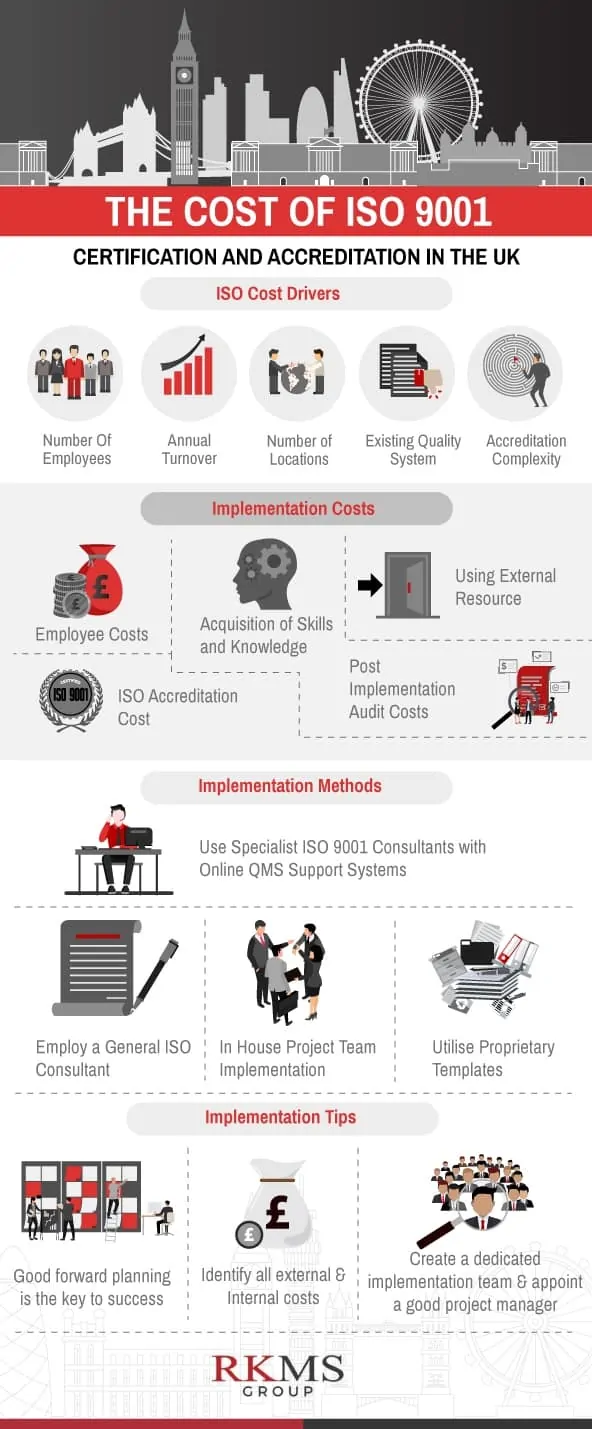
ISO 9001 Cost of Certification

ISO 9001 Certification Cost in the UK (Realistic Pricing Explained)

If you’re researching ISO 9001 certification cost, you’ll quickly notice that prices quoted online vary dramatically – often without explaining why.

The reality is that ISO 9001 cost in the UK depends heavily on how much of a system already exists within your business.

This guide explains the true ISO 9001 cost of certification, including:

  • When lower costs are possible
  • When higher costs are unavoidable
  • How to budget realistically and avoid misleading quotes
Iso 9001 certification cost

What Is ISO 9001 Certification?

ISO 9001 is the international standard for quality management systems (QMS). It provides a structured framework for controlling processes, improving efficiency, and consistently meeting customer requirements.

For many UK organisations, ISO 9001 certification is essential for:

  • Winning tenders and frameworks
  • Meeting supply chain requirements
  • Demonstrating operational control

Many businesses choose to work with professional ISO 9001 consultancy services
to ensure their quality management system is implemented correctly, reflects how the business actually operates, and is ready for UKAS-accredited certification audits.

ISO 9001 cost of certification

How Much Does ISO 9001 Certification Cost in the UK?

Realistic ISO 9001 Cost Ranges (UK)

ScenarioTypical Cost
ISO 9001 built from scratch£6,700 – £11,000+
Existing processes already in place£5,200 – £8,000
Highly organised, low-risk business (rare)From £3,250

👉 Most UK businesses should realistically budget £5,200+ for ISO 9001 consultancy, plus certification body fees.

This reflects the cost of doing ISO 9001 properly, not simply generating paperwork.

Why £3,250 ISO 9001 Is Possible - But Extremely Rare

It is possible to achieve ISO 9001 at around £3,250, but only where:

  • Processes are already clearly defined
  • Documentation is largely in place
  • Management commitment is strong
  • The business is low-risk and small
  • Minimal consultant input is required

These cases are exceptions, not the norm. Most organisations underestimate the time and expertise required to meet ISO 9001 requirements properly.

ISO 9001 Consultant Costs Explained

For the majority of UK organisations, ISO 9001 consultancy involves:

  • Gap analysis against ISO 9001
  • Building or refining a compliant QMS
  • Aligning documentation to real processes
  • Internal audit support
  • Management review support
  • Preparation for UKAS certification audits

Because of the time, expertise, and level of involvement required, this depth of support usually places ISO 9001 consultant costs at £5,200 or more for most businesses. Working with an experienced ISO 9001 consultant in the UK
helps ensure the system is robust, audit-ready, and tailored to your organisation rather than a generic, template-based solution.

UKAS Certification Body Costs (Minimum £1,500)

Regardless of how prepared you are, UKAS-accredited certification bodies charge their own fees.

Typical costs are:

  • From £1,500 for very small, low-risk businesses
  • £2,000–£3,000+ for SMEs and higher-risk sectors

These costs are based on:

  • Number of employees
  • Business risk category
  • Audit time required

Total ISO 9001 Cost of Certification (Year One)

When consultancy and certification are combined, realistic ISO 9001 certification cost UK figures are:

  • £6,700 – £11,000+ (from-scratch implementations)
  • £5,200 – £8,000+ (where systems already exist)
  • From £3,250 (rare, highly prepared organisations)

Ongoing ISO 9001 Costs After Certification

ISO 9001 certification operates on a three-year cycle, with ongoing costs including:

  • Annual surveillance audits (£750 – £1,500 per year)
  • Internal audits and management reviews
  • Continuous improvement and system updates

These ongoing commitments should always be factored into the true ISO 9001 cost, not just the initial certification.

How to Control ISO 9001 Cost Without Cutting Corners

Controlling ISO 9001 cost doesn’t mean taking shortcuts. It means implementing the standard efficiently and in a way that genuinely supports how your organisation operates.

Key ways to manage costs include:

Many organisations choose to manage these factors by working with experienced ISO consultancy services that focus on building management systems around existing processes. This approach helps control ISO 9001 costs without cutting corners or compromising compliance.

Is ISO 9001 Worth the Cost?

For most UK businesses, ISO 9001 certification delivers a strong return through:

  • Improved tender success
  • Greater operational control
  • Reduced inefficiencies and errors
  • Increased customer confidence

When implemented correctly, ISO 9001 becomes a practical management tool – not just a certificate.

Get a Realistic ISO 9001 Cost for Your Business

Because no two organisations are the same, the only way to know your true ISO 9001 certification cost is through an initial assessment.

👉 Speak to an experienced ISO 9001 consultant who will assess what you already have in place and give you an honest, realistic quote.

✅ Start Here:

ISO 9001 Consultant – UK Specialists

Share

Book a Free Consultation Consultation Consultation Consultation

Get free advice and guidance tailored to your business needs

Related Resources

Book a Free Consultation Consultation Consultation Consultation

Get free advice and guidance tailored to your business needs

10 Benefits of Lean Management

10 Benefits of Lean Management

ISO Certification for Tenders

You’ve probably heard of lean management. But are you aware of just how much implementing it can benefit your company? Perhaps not. But we’re about to change that.

Here’s why you should integrate lean management into your business.

The 10 Benefits of Lean Management

Table of Contents

Improved Quality Control

Quality control goes hand-in-hand with productivity. You can’t really change one without the other. Lean management systems help your organisation to realise that quality control should be one of your top priorities. Upon implementation, you will undoubtedly reach a stage where our second point (reduced waste) naturally happens.

Reduced Waste

Many businesses struggle with exorbitant waste. However, the more problematic companies don’t realise they have this issue. This mindset is harmful but with lean management, waste is considered by employees on every level. Your company will see waste reduction almost immediately.

Boost Team Morale

There’s no doubt about; businesses working under lean management have higher employee satisfaction rates. The reason for this is the improved trust and communication lines between management and staff that open under this system. Not only does better team morale benefit the individuals, but it’s also known to increase productivity across the board.

Enhanced Efficiency

Arguably, improved efficiency is one of the more noticeable effects of lean management. You’ll see this improvement in different ways depending on the method you use to measure progress and success.

Better Stakeholder Visibility

Stakeholders like to clearly see how a project is going, as well as any associated risks. With lean management, communication and reporting are improved, thus allowing stakeholders a better view of the project.

Predictable Customer Value

Lean management focuses on the customer’s opinion first and foremost. Over time, clients will come to know the high-quality outcomes they can expect when working with you. This is essential for ensuring consistent satisfaction and building a strong, positive reputation.

Decreased Costs

By cutting production throughput, decreasing inventories, and eliminating unnecessary waste, your organisation’s costs will drastically decrease. By how much? This system has been known to cut manufacturing costs by up to half.

Improved Priority Shift Management

Just like life, legislation and customer viewpoints change all the time. To keep up with this continuous adaptation, your business must shift its priorities. Otherwise, you’ll be working toward worn-out ideas that will not only decrease customer satisfaction but also increase your costs.

Increased Process Stability

Under lean management, your business can begin to focus more on deviation management and exploring solutions to remove them. When you first start working this way, it might feel counter-productive. However, it’s worth implementing a deviation management process in the first phase to use lean to its full advantage.

Adopt an Improvement Culture

Overall, lean management allows your company to focus on continuous improvement instead of maintenance. This new way of working means that your employees will always be looking for ways to better themselves for the team — yes, every day. You’ll see an overwhelming advancement in all aspects of your business over time.

Interested in implementing a lean project within your organisation?

Our lean programme, which attracts 95% funding, has run for over 20 years throughout the UK and has been applied to nearly every industry. To date the programme has identified in excess of £65m in benefits across 650+ companies.

Talk to us today to see how the programme can assist your business.

Share

Book a Free Consultation Consultation Consultation Consultation

Get free advice and guidance tailored to your business needs

Related Resources

Book a Free Consultation Consultation Consultation Consultation

Get free advice and guidance tailored to your business needs

What is ISO 9001:2015?

What is ISO 9001:2015?

What is ISO 9001:2015?

Found yourself wondering what ISO 9001 is? Can’t quite figure out whether it’s right for your organisation? Whatever aspect of ISO 9001 you’re interested in, you’ve found the right place.

We’re going to look at the what, the why, and the history of the elusive ISO 9001.

Let’s start with the “what”.

What is ISO 9001:2015?

ISO 9001 is the international standard for any quality management system (otherwise known as a QMS). To become “ISO 9001 Certified” your business has to meet the specific criteria stated in the ISO 9001 Standard.

Organisations use it to prove to their customers that they provide reliable, high-quality products, or services and that they’re willing to continuously improve their offerings.

A More In-Depth Look at ISO 9001:2015

While there are a lot of documents in the ISO 9000 Family of Standards, the only one requiring any kind of certification is the ISO 9001.

Generally speaking, an entire company will look to gain the certificate. However, the scope of the standard can be changed by a particular department.

Currently, the version that you need to adhere to is ISO 9001:2015. Here are some useful points to note as you move on to learn even more about this standard:

  • There is no “ISO 9000 Certificate”. Only the ISO 9001 certificate exists.
  • It’s not a membership group or entity. You can’t simply sign up. Instead, your organisation will need to do the following:
        • Take steps to include the ISO 9001 quality management system in your organisation.
        • Allow a Certification Body to audit your organisation against the ISO 9001 requirements.
        • If you pass this audit, you’ll be given registration for three years. You have to re-register after that.

The ISO 9001:2015 Requirements

In ISO 9001, there are 10 clauses that your organisation’s or department’s QMS (Quality Management System) must adhere to in order to gain certification.

These sections are extremely detailed and can vary depending on the industry. However, we’ll look at the basic overview of each clause so you can gain a better understanding of the criteria.

  • Scope — Defines the scope of the current 9001 standard including a list of all requirements.
  • References — Lists the standards supported by the current 9001.
  • Terms — Defines the terms used throughout the standard.
  • Context — Relates to how your organisation determines the objectives and scope of your QMS.
  • Leadership — Refers to how leadership is responsible for communicating the quality procedures.
  • Planning— Addresses opportunities, quality objectives, changes, and risks.
  • Support — The resources required for the QMS and ensures all employees are aware of all relevant information.
  • Operation — Relates to the plan and control procedures required to meet the right standards for services/products.
  • Evaluation — To qualify for ISO 9001, your company must use your QMS to effectively monitor and analyse the QMS itself as well as the business processes.
  • Improvement — Everything pertaining to continuous improvement. 

Now you’re more aware of the ins and outs of ISO 9001, let’s take a look at its origin.

A Brief History of the ISO 9001:2015 Quality Management System

The ISO 9001 standard can be traced back to the 1950s when both the UK and US governments started implementing standards for the military. At this stage, the standard was only used for large companies supplying the military to ensure a specific quality was always met.

This led to the creation of mutual recognition within the defence industry. What was this called? The NATO AQAP and MIL-Q.

In 1979, the BS5750, a quality management system standard, was created. This proved to be incredibly successful and eventually led to the first ISO 9001 standard being passed in 1987.

Since that time, the standard has been reviewed once every 5 to 8 years, just to ensure that it still meets the current international business environment.

Who is ISO 9001:2015 for?

Essentially, ISO 9001:2015 is for any organisation that wants to give its customers proof that they can work to a consistently high standard.

Having said this, you need to make sure you follow these guidelines to be eligible:

  • A single person can’t gain certification. It must be a company that seeks qualification.
  • The size of the organisation doesn’t matter.
  • The industry doesn’t matter.
  • It is not a standard that relates to products. It doesn’t prove product quality. Instead, it’s used to control your company’s processes. 

As long as you fit these requirements, ISO 9001 is for you!

The Benefits of ISO 9001:2015

The standard has proved to be beneficial not only for your company but for your customers too. The advantages that ISO consultancy support can provide to help you gain certification are seemingly limitless so it’s wise to familiarise yourself with at least a few of them.

The Benefits of ISO 9001:2015 for your Company

We’ll start with the benefits for your company.

1. Efficiency and Revenue Increase

The standard allows you to focus on the quality of your processes and procedures to increase the end result. Your revenue will boost due to this new-found efficiency.

2. Better Record Keeping

ISO 9001 ensures all your processes are recorded from the beginning to the end. This will help you deal with complaints easily and streamline your procedures.

3. Keep Improving

Since trend analysis is a huge part of ISO 9001, you will be better able to continuously improve your company. In turn, this will give you even greater profits.

4. Boost Employee Morale

The standard allows you to focus on the quality of your processes and procedures to increase the end result. Your revenue will boost due to this new-found efficiency.

The Benefits of ISO 9001:2015 for your Customers

1. Fewer Reasons for Returns

With ISO 9001, you will be able to spot and resolve problems quickly, meaning the customer won’t ever have to know. Thus, stopping them from returning products or requesting refunds.

2. Improved Customer Relationships

The standard sets out ways for your company to increase the quality of the relationships you hold between customers or shareholders. This improves the chances of having returning customers.

Final Thoughts

It’s safe to say that ISO 9001 is an in-depth standard that can take a while to wrap your head around. You’ll have gained a great deal of understanding here but be sure to delve deeper to find out exactly how your organisation can qualify.

Do you want us to take care of your ISO 9001 journey?

At RKMS we have over 25 years worth of experience in assisting companies achieve ISO 9001 with a 100% success rate. All our consultants are IRCA lead auditors so we know exactly what the auditors want to see.

Share

Book a Free Consultation Consultation Consultation Consultation

Get free advice and guidance tailored to your business needs

Related Resources

Book a Free Consultation Consultation Consultation Consultation

Get free advice and guidance tailored to your business needs