What are External Audits?

What are External Audits?

What are External Audits

What to Expect from External Audits and ISO Certification

Audits are an important part of a company’s application for ISO certification. These tests and inspections can verify if the processes and systems comply with standards and follow best practices. They can identify areas that need improvement or provide proof that the company has met the ISO requirements.  

ISO certification requires both internal audits and external audits. In this article, we’ll look at the latter—including the types of audits you will need, what the auditor will look for, the steps and time involved, and tips on preparing for them.

The External Audit Process

External audits will examine your business from different perspectives and points of view and are conducted in stages.  

An external audit is done by a third-party auditor who is licensed by the Certification Body. Usually, the auditors are selected based on their experience, qualifications, as well as their understanding of your specific industry.

During the three-year cycle of ISO certification, you can expect least one day initial audit of all your processes, and another one audit during the surveillance cycle to check whether the recommendations have been effective.  

Types of External Audits

Customer Audit

The first step is the Customer Audit, where a potential or existing customer reviews your processes from the lens of whether you are able to meet their needs, expectations and requirements. For some businesses, this can be replaced or augmented by a supplier audit. The schedule of auditing varies from customer to customer.

Certification Audit

This is a critical step in the ISO process. Your registrar will do a thorough check of your business processes and practices to check if they conform to the ISO standard. You can expect to have this done every three years.

Stage 1 is a preliminary audit that determines your company’s level of readiness for ISO. This allows you to spot areas where you need to improve, or understand the documents and reports that you need to provide. This is sometimes done remotely.

Stage 2 is a more thorough, on-site inspection where the auditor will review procedures, interview your employees, and check if you meet the criteria for an official ISO certificate.

Surveillance Audits

Even after your company gets ISO certification, your registrar will do annual surveillance audits. Much like a car tune-up or the annual doctor check-up, this external audit determines if you are still meeting the ISO requirements or if there are areas that need to be improved or revised. Should you have received any non-conformities or areas for improvement on your stage 2 audit. The Surveillance Audit will be focused on what you have done to correct the issues.

You will not be given a new certificate, but this is required so you can keep your ISO certification.

Methods and Processes

Audits can be performed in different ways, depending on your company’s needs and what is being checked. This can include remote audits which include teleconferences or online consultations, on-site audits, and self-audits.  

The self-audits can help you prepare for the official external audits. You can select employees to join the audit team, but they shouldn’t audit their department or area of responsibilities. You can also hire professional auditors who can train or guide this team, or completely outsource the internal audit to them.

While the external audit is clearly the most critical part of getting ISO certification, an internal audit is what helps you meet the criteria. Conduct one at least three months before you do a certification audit, and make sure that you document the process.

The internal audit will help you find out your “non-conformities” or where you do not meet criteria and create an action plan. These records will actually be reviewed during the external audit and can make or break your company’s ability to proceed to the next step.

For that reason, it’s worth utilising professional auditors from respected ISO 9001 consultants even during the internal audit stage in order to lay the proper groundwork for the rest of the process.

How to Prepare for an External Audit

  • Use the PDCA model. PDCA stands for “Plan Do Check and Act”. It is one of the best approaches for business improvement, and can help give you a systematic, verifiable way of meeting the ISO criteria.  Plan includes identifying your competencies and gaps, and then create a strategy. Do includes your action plan, including your activities and the timelines. Check refers to monitoring and evaluating your progress, and Act means creating your next steps based on the results.
  • Create process documents and checklists for all business activities. Your auditor will check if employees follow best practices as they go about their work. In order to train your employees, and provide your auditor with a guide, create a process document. This prevents inconsistencies, and expedites the auditing process.
  •  Check employee intent and effectiveness. Ask employees to describe their work, and then review if they are able to do it – and do it effectively.  While ISO often looks at the big picture, this step enables you to see beyond compliance and actually understand if your company processes enable productivity and high performance.

These are just some of the things you can expect during an external audit, and what you can do to prepare for it. Your auditor can help answer your questions, or provide more specific plans and checklists.  

Share

Book a Free Consultation Consultation Consultation Consultation

Get free advice and guidance tailored to your business needs

Related Resources
Book a Free Consultation Consultation Consultation Consultation

Get free advice and guidance tailored to your business needs

Maintaining your ISO Certification

Maintaining your ISO Certification

Maintaining ISO Certification

Earning and maintaining the right ISO certification (like ISO 9001 or ISO 27001, for example) is critically important for businesses that want to compete in the 21st century.

An international standard that can either open doors to opportunities that would not have existed otherwise or cause great businesses to lose a lot of sales and credibility in their industry, it is not just enough to earn the ISO certification – it’s important to maintain that certification moving forward, too.

Below we highlight important details that will better illuminate the ISO certification process as well as the ongoing maintenance routine that businesses will need to adhere to.

Let’s get right into it.

Choosing the Right Standard

While ISO 9001 is often the most popular of the ISO standards to move forward with, there are other options to consider as well.

Let’s run through them quickly:

  • ISO 9001 – This standard focuses on management and organisational processes, improving efficiency across the board
  • ISO 14001 – This standard deals mostly with environmental management standards
  • ISO 27001 – This standard focuses exclusively on cybersecurity, letting the international business community better understand how seriously your operation takes data protection and digital privacy rights
  • ISO 45001 – This is the standard that pertains most to health and safety standards

All of the standards have ongoing certification procedures that go beyond the initial certification process. We talk more about that in just a moment.

Choosing the Right Certification Organisation

Choosing the right ISO standard is (obviously) important, but so is choosing the right certification organisation.

For starters, you’ll want to choose an organisation that has United Kingdom Accreditation Service (UKAS) accreditations. This accreditation is the only accreditation recognised by the government for not only providing the initial certification but also testing and handling ongoing certifications, too.

From there, you’ll want to look into the reputation of the certifying body as well.

Have a look at the reviews that organisation has, dig deeper into the testing protocols that they take advantage of, and see if they provide any extra value on top of the certification and ongoing certification procedures they offer.

Above all else, make sure that they are a legitimate organisation. The last thing you want to worry about is pursuing ISO certification and ongoing certification only to find out that opportunities start to disappear because the accrediting body was in some way illegitimate or not UKAS approved provider.

How Long Does Certification Take?

Each ISO certification process is going to unfold in a unique pattern, dependent entirely upon the size of that organisation as well as the structure of that company, too.

To streamline things significantly, it’s important to designate a specific representative of your business that will move through the ISO certification process and handle ongoing certification, too.

You do not necessarily have to hire a “Quality Manager” or “Compliance Manager” with these kinds of responsibilities exclusively in their purview, but you are going to want to make sure that a management or executive level employee is spearheading the initial and ongoing certification process.

As a general rule of thumb, it’s not a bad idea to expect that the entire ISO initial certification process to take anywhere between four months and seven months to be completed. It may take a little bit longer than that to be awarded this certificate from an accredited agency, but it will very rarely take less than three months.

The Ongoing Certification Process

Ongoing certification, however, is a “permanent” process that will involve (at the very least) one surveillance audit each and every year.

The surveillance audits are designed to ensure that ISO certified organisations are continuing to take advantage of these principles, continuing to leverage your management systems, and are still embracing and embodying all that the ISO certification embodies.

On top of the on-site surveillance audits that will happen at least once per year a written report may be required as well.

Every three years businesses are required to undergo a complete recertification audit from top to bottom.

This kind of recertification audit involves a deeper look at the entire business structure, the strengths and weaknesses of that particular business, and the creation of a plan to better optimise things going forward.

Third-year audits are significantly more extensive and a lot more time intensive than traditional on-site annual audits. Unsurprisingly, these in-depth audits are usually more expensive as well.

Businesses should also know that while an ISO 9001 consultancy (especially one  that is accredited through the UKAS) is entitled and empowered to provide insight and information into their findings, they aren’t allowed to cross the line between objectivity and impartiality.

Most of these agencies will try and provide informational resources about how there ISO ongoing certification clients can best move forward, often times pointing them towards best practices and shining a light on what can be improved without abandoning their core principles.

At the end of the day, it’s important to remember that the ongoing certification process is intended not just to confirm that businesses are still abiding by ISO principles but that they are continuing to find new ways to fold ISO principles into a business that grows and evolves over time.

Clear goals, open lines of communication across all levels of management and staffing, and regular trainings regarding ISO certification and best practices will go a long way towards making sure that ongoing certification is relatively simple, straightforward, and almost effortless.

It is never a bad idea conduct internal audits quarterly to prepare for the annual surveillance audit, either.

This will ensure compliance, help to find inefficiencies wherever they might exist, and to guarantee that there are not any surprises that pop up when the auditors are actually brought in to do their official certification.

Annual audits can also be a great time to address any of the major or minor nonconformities and observations that were discovered during the more traditional surveillance or three-year audits as well.

Take advantage of every opportunity to adhere more closely to ISO standards and ongoing certification turns into just another day at the office.

Share

Book a Free Consultation Consultation Consultation Consultation

Get free advice and guidance tailored to your business needs

Related Resources

Book a Free Consultation Consultation Consultation Consultation

Get free advice and guidance tailored to your business needs

10 Benefits of ISO 9001

10 Benefits of ISO 9001

Benefits of ISO 9001

The 10 Benefits of ISO 9001

Table of Contents

Increase Efficiency

Companies that go through the ISO 9001 certification process have to give a lot of thought to their processes and how they can maximise quality and efficiency. ISO 9001 sets the bar internationally that it is the standard to have.

Increase Revenue

Studies have shown that ISO 9001 certified companies experience increased productivity and improved financial performance, compared to uncertified companies. This goes hand in hand with winning new contracts, tenders etc.

Employee Morale

Defined roles and responsibilities, accountability of senior management, established training systems and a clear picture of how their roles affect quality and the overall success of the company, all contribute to more satisfied and motivated staff. Once you have the buy in from your staff, they are less likely to leave meaning no extra costs with rehiring and training.

International Recognition

The International Organisation for Standardisation (ISO) is recognised worldwide as the authority on quality management. With membership now exceeding 160 you can see why it’s the go to standard. http://www.iso.org/iso/about/iso_members.htm

Factual Approach to Decision Making

The ISO 9001 standard sets out clear instructions for internal audits and processes with self-assessment being high on the agenda, in turn, this makes information gathering and decision making most efficient. 

Supplier Relationships

If you have clients, then you will have suppliers and by employing the processes set out you will be able to find a mutually beneficial supplier relationship. The process also requires thorough evaluation of new suppliers before a change is made and/or consistency with respect to how and where orders are placed.

Documentation

The bane of most companies’ existence is documentation. Having the ISO 9001 in place helps keep everything on an even keel without being so intrusive you cannot function.

Consistency

One of the foundations of ISO; All processes from research and development, to production, to shipping, are defined, outlined and documented, minimising room for error. Even the process of making changes to a process is documented, ensuring that changes are well planned and implemented in the best possible way to maximise efficiency.

Customer Satisfaction

Client confidence is gained because of the universal acceptance of the ISO standard (160+ countries) Customer satisfaction is ensured because of the benefits of ISO 9001 to company efficiency, consistency and dedication to quality service.

Improvement Processes

The ISO 9001 outlines audit processes, management review and improvement processes based on collected data. Improvements are carefully planned and implemented based on facts, using a system of documentation and analysis, to ensure the best decisions are made for your company – see more here.

Do you want us to take care of your ISO 9001 journey?

At RKMS we have over 25 years worth of experience in assisting companies achieve ISO 9001 with a 100% success rate. All our consultants are IRCA lead auditors so we know exactly what the auditors want to see.

Share

Book a Free Consultation Consultation Consultation Consultation

Get free advice and guidance tailored to your business needs

Related Resources

Book a Free Consultation Consultation Consultation Consultation

Get free advice and guidance tailored to your business needs

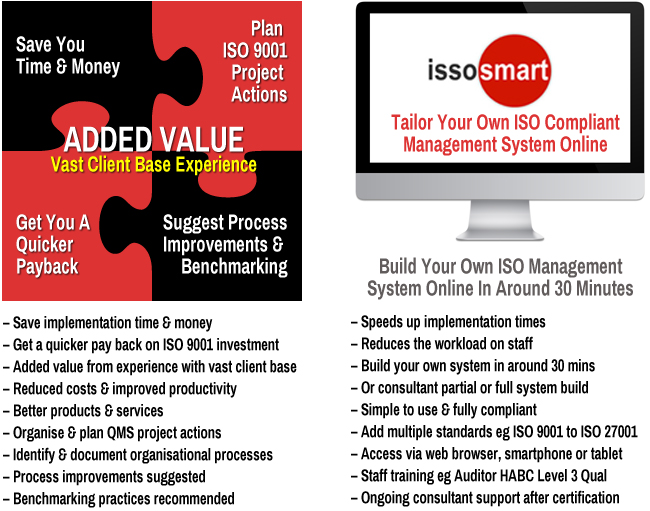
How issosmart™ can assist you with ISO compliance

How issosmart™ can assist you with ISO compliance

Being ISO compliant, whether it’s required by law or not, has become a necessity in business these days. Companies that wish to develop efficiencies in business processes, solve recurring problems and provide better customer service on a consistent basis opt for ISO certification – it becomes a way to promote your brand to the marketplace.

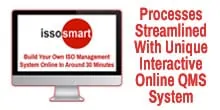
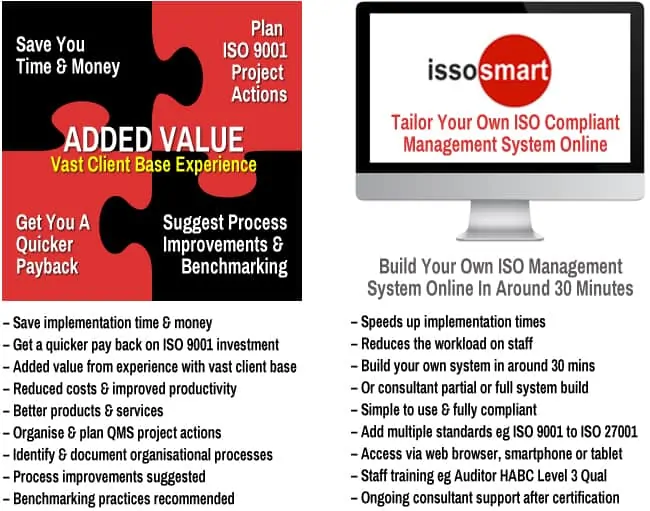
The online issosmart™ tool allows companies to set up a customised ISO compliant management system in a mere 30 minutes or so. At the end, the complete roster of documents – user guide, manual, registers, forms and procedures – required for ISO compliance will be at your fingertips.

Trust the smart consultants behind issosmart™

The issosmart™ tool has been designed by the RKMS Group, a UK based management consulting company with a stellar track record – in fact a 100% success rate – over its 25+ years of existence. All consultants on your project will be IRCA lead auditors.

Besides issosmart™, RKMS also provides services focused on ISO 9001, ISO 14001 and ISO 45001; Lean Management; Primary Risk Manager – an online Fire Risk Assessment tool and Accredited Training Courses.

Easy to setup, implement and use

An ISO implementation process often involves tedious paperwork to stay current, input updates and comply with audits. No more!

issosmart™ is not only easy to install, set up and access through your company web browser, it will take the pain out of updates and audits. RKMS’s process includes an automatically updated legal register, which guarantees compliance with legal standard.

Other features include, but are not limited to:

  • The ability to add and implement according to multiple standards
  • Ultimate ease of access – via computer, tablet and smartphone
  • Ability to generate business insights through setting up and tracking KPIs

Overall, this is a system YOU design – its tailored to your specific needs and laser focused on reducing your costs of operation and implementation while improving the core efficiencies of your business processes.  

issosmart™ will help to streamline your business and eliminate redundancies and unnecessary activities.

Be sure to ask about training

RKMS offers accredited training to help companies achieve and maintain ISO compliance.

The Level 3 Award in Effective Auditing and Inspection is awarded to those who have gained the specific knowledge required to conduct internal audits.

Contact RKMS Group today

Set up a free consultation with one of our experts today!

RKMS provides expert ISO 9001 consultant guidance, both email and phone support, plus training on issosmart™ as required. Our customer service representatives are always ready to support your needs.

Share

Book a Free Consultation Consultation Consultation Consultation

Get free advice and guidance tailored to your business needs
Related Resources

Book a Free Consultation Consultation Consultation Consultation

Get free advice and guidance tailored to your business needs

What is PAS 2060?

What is PAS 2060?

What is PAS 2060?

PAS 2060: A Guide to Getting Certification and Contributing to the Race Against Global Warming

Global warming and climate change are a serious problem. If we do not act now—and countries, companies and communities do not work together to lower the emissions of carbon dioxide and other heat-trapping gases—the Earth will be inhabitable. We destroy the planet, millions of plant and animal species, and the entire human race.

That is why the industrial and business sectors are working to reduce carbon emissions and become “carbon neutral”. They are replacing fossil fuels with renewable energy, reducing waste, and looking for sustainable materials and packaging.

But the most important step that a company can take to reduce its carbon footprint is to analyse its greenhouse emissions. You have to know the problem before you can solve it. That is where the PAS 2060 standard can help.

What is the PAS 2060 standard?

The PAS 2060 standard is the only internationally recognised, accepted and respected standard for carbon neutrality.

It is based on the PAS 2050 standard, which was first released in 2008 by the British Standards Institution. This was the first framework for measuring a company’s carbon footprint.  

The updated PAS 2060 standard, which was released in 2014, has a more detailed methodology for measuring the life cycle of greenhouse gases across the entire value chain. Companies can use this to measure reduce and offset emissions, and the impact of their goods and services on climate change.

Ho do you apply for PAS 2060 certification?

The PAS 2060 methodology and framework has four steps, which require both a thorough evaluation of your processes and verification from accredited bodies.

  1. Measure Emissions
  2. Reduce Emissions
  3. Offset Emissions
  4. Document Success

Mesure Emissions

PAS 2060 divides emission sources from different areas, called Scopes.

  • Scope 1 includes direct emissions like fuel combustion. This is under the company’s direct control.
  • Scope 2 includes indirect emissions, which are created by electricity, heating, or cooling. This is not under the company’s control, but can be properly managed or minimised.
  •  Scope 3 includes emissions from activities that are part of the business value chain, but are beyond the control. This can include transportation or waste treatment.

To get PAS 2060 certification, companies must meet standards for Scope 1 and 2, and limit Scope 3 emissions to 1% of their total footprint.

Reduce Emissions

The next step in PAS 2060 certification is to present a Carbon Management Plan, which includes a timeframe, specific targets, and how they plan to reduce or offset emissions. Each activity should have a justification, and provide a methodology and timeframe for measurement.  

The company must also make a public commitment to carbon neutrality, and declare a maximum amount of annual emissions, or the ratio of emissions per unit of production.

Offset Emissions

To achieve carbon neutrality, companies don’t just have to reduce emissions but offset them. This can include investing in environmental projects like tree planting, using clean energy technology or programs like capturing methane gas from landfills, or buying carbon credits.

Unfortunately, carbon offsetting has generated a lot of public mistrust, after several reports of abuse and fraud. To avoid a backlash, make sure to engage in quality programs that provide real environmental benefits.

The offset credits must also be documented and verified by an independent third party, and meet the criteria. There are different standards for the compliance market and voluntary market, so you should know where the programs fall under and the necessary requirements.

Any offset credits have to be used within 12 months from the date they have been declared to be achieved.

Document Success

At the end of the program, the company must present a report, which includes supporting documents such as a copy of their Carbon Management Plan, proof of reduced emissions, and the Carbon Footprint Report.

Who can apply for PAS 2060 certification?

Companies and organisations can get carbon neutral certifications for products, services, buildings or sites, transportation systems, and even events.

What are the benefits of applying for PAS 2060?

  • Stronger brand image. Being an environmentally responsible company or brand can help build customer trust and loyalty, and improve your relationships with stakeholders. This includes the media, local government, stockholders, and investors.   
  • Increased credibility. You will be able to declare certification on product labels and marketing collaterals. Since PAS 2060 is the only internationally recognised standard, you immediately differentiate yourselves from other companies who can only “claim” that they are Clean and Green.
  • Clear action plans. The PAS 2060 framework can help you find clear, concrete and cost-effective ways to lower your carbon emissions. This is better than blindly implementing projects without knowing the real impact on your business and global decarbonisation efforts.

Align your business with global initiatives

The PAS 2060 framework also companies align with a global target, set by the 2015 Paris Agreement. You could call it the biggest business plan in history: world governments committed to lower the rise of global temperature to below 2°C, in order to prevent the catastrophic effects of climate change.  

The only way to meet this goal is for companies worldwide to cut emissions by 50% before 2030, and achieve net-zero by 2050. The clock is ticking. While everyone plays an important role, most carbon emissions are generated by the business and industrial sector.

Unfortunately, total carbon emissions increase every year. Even with the existing commitments from countries, we are still producing 60% more carbon than safe levels. In other words, companies need to try harder. It is not enough to “reduce, reuse and recycle” while hoping that it is enough.

The PAS 2060 framework provides a more systematic way to reduce emissions and measure success.  It can serve as the foundation for long-term environmental strategies, while setting milestones for every year. It can be a tedious procedure, but there are companies that can assist with the process, from developing a plan to gathering the necessary documents, reports, offsetting credits, and third-part accreditation.  

With the global warming crisis, PAS 2060 is not just a standard, but a tool for survival.  

Do you want us to take care of your PAS 2060 journey?

At RKMS we have over 25 years worth of experience in assisting companies achieve PAS 2060 with a 100% success rate. All our consultants are IRCA lead auditors so we know exactly what the auditors want to see.

Share

Book a Free Consultation Consultation Consultation Consultation

Get free advice and guidance tailored to your business needs

Related Resources

Book a Free Consultation Consultation Consultation Consultation

Get free advice and guidance tailored to your business needs
10 Benefits of ISO 14001 in 2026

10 Benefits of ISO 14001 in 2026

Benefits of ISO 14001

So you’re probably familiar with what ISO 14001 is, but maybe you’re thinking why your business would need it? Or whether it is worth the effort?

Here’s some reaons for why ISO 14001 can benefit your business.

The 10 Benefits of ISO 14001

Table of Contents

Improve Tender Chances

It increases chances of winning public and private sector tenders. It has become more and more important over the last 10 years for companies to show that they are thinking but also following the green trend.

Leaders in Industry

It will make your competitors take note that you are going above and beyond of what is expected from someone in your industry.

Ensure Legal Compliance

It helps your organisation meet legal and regulatory requirements. It does depend on which sector you work within but having the 14001 in place will eliminate any potential banana skins for you.

Reduce Insurance Premiums

It can lower insurance premiums. It has been shown time and again that lowering risks make you safer which in turn reduces premiums.

Improve Environmental Performance

It reduces consumption of raw materials. We all have an impact on mother earth however if we can highlight and reduce the impact it can only be good for everyone.

Reduce Operational Waste

It reduces waste and repetition. As you will be looking at your operations we will be able to identify where you are using too much raw material and where savings could be found.

Increase Profitability

It increases profit margins. If you reduce your waste, it’s not only good for the planet but good for the balance sheet.

Increase Efficiency

It streamlines operations. If we can streamline what you do it will naturally make things work more efficiently.

Improve Employee Morale

It can increase employee motivation and participation. What be buy in is the staff, and with a proper process in place staff will be able to see their development into an import cog in the business wheel.

Promotes Continual Improvement

It promotes continual improvement. How can improvement be bad? Answer it can’t.

Do you want us to take care of your ISO 14001 journey?

At RKMS we have over 30 years worth of experience in assisting companies achieve ISO 14001 with a 100% success rate. All our consultants are IRCA lead auditors so we know exactly what the auditors want to see.

Share

Book a Free Consultation Consultation Consultation Consultation

Get free advice and guidance tailored to your business needs
Related Resources

Book a Free Consultation Consultation Consultation Consultation

Get free advice and guidance tailored to your business needs
ISO 9001 Cost of Certification

ISO 9001 Certification Cost in the UK (Realistic Pricing Explained)

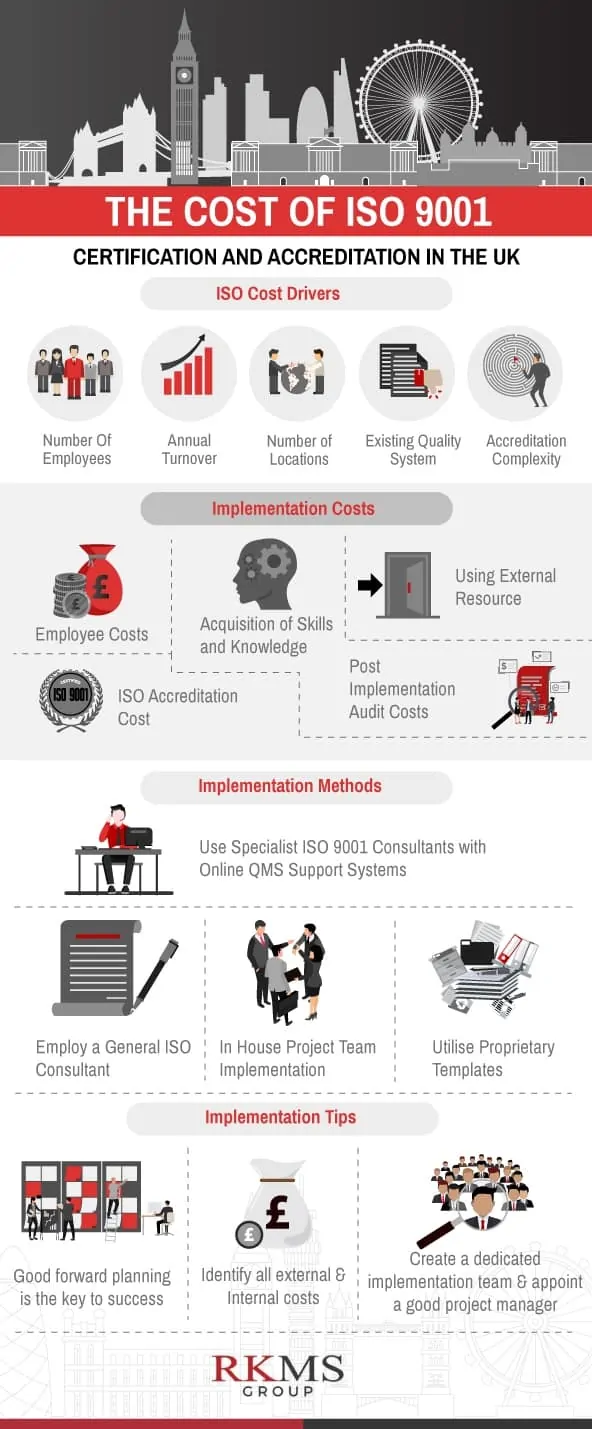
If you’re researching ISO 9001 certification cost, you’ll quickly notice that prices quoted online vary dramatically – often without explaining why.

The reality is that ISO 9001 cost in the UK depends heavily on how much of a system already exists within your business.

This guide explains the true ISO 9001 cost of certification, including:

  • When lower costs are possible
  • When higher costs are unavoidable
  • How to budget realistically and avoid misleading quotes
Iso 9001 certification cost

What Is ISO 9001 Certification?

ISO 9001 is the international standard for quality management systems (QMS). It provides a structured framework for controlling processes, improving efficiency, and consistently meeting customer requirements.

For many UK organisations, ISO 9001 certification is essential for:

  • Winning tenders and frameworks
  • Meeting supply chain requirements
  • Demonstrating operational control

Many businesses choose to work with professional ISO 9001 consultancy services
to ensure their quality management system is implemented correctly, reflects how the business actually operates, and is ready for UKAS-accredited certification audits.

ISO 9001 cost of certification

How Much Does ISO 9001 Certification Cost in the UK?

Realistic ISO 9001 Cost Ranges (UK)

ScenarioTypical Cost
ISO 9001 built from scratch£6,700 – £11,000+
Existing processes already in place£5,200 – £8,000
Highly organised, low-risk business (rare)From £3,250

👉 Most UK businesses should realistically budget £5,200+ for ISO 9001 consultancy, plus certification body fees.

This reflects the cost of doing ISO 9001 properly, not simply generating paperwork.

Why £3,250 ISO 9001 Is Possible - But Extremely Rare

It is possible to achieve ISO 9001 at around £3,250, but only where:

  • Processes are already clearly defined
  • Documentation is largely in place
  • Management commitment is strong
  • The business is low-risk and small
  • Minimal consultant input is required

These cases are exceptions, not the norm. Most organisations underestimate the time and expertise required to meet ISO 9001 requirements properly.

ISO 9001 Consultant Costs Explained

For the majority of UK organisations, ISO 9001 consultancy involves:

  • Gap analysis against ISO 9001
  • Building or refining a compliant QMS
  • Aligning documentation to real processes
  • Internal audit support
  • Management review support
  • Preparation for UKAS certification audits

Because of the time, expertise, and level of involvement required, this depth of support usually places ISO 9001 consultant costs at £5,200 or more for most businesses. Working with an experienced ISO 9001 consultant in the UK
helps ensure the system is robust, audit-ready, and tailored to your organisation rather than a generic, template-based solution.

UKAS Certification Body Costs (Minimum £1,500)

Regardless of how prepared you are, UKAS-accredited certification bodies charge their own fees.

Typical costs are:

  • From £1,500 for very small, low-risk businesses
  • £2,000–£3,000+ for SMEs and higher-risk sectors

These costs are based on:

  • Number of employees
  • Business risk category
  • Audit time required

Total ISO 9001 Cost of Certification (Year One)

When consultancy and certification are combined, realistic ISO 9001 certification cost UK figures are:

  • £6,700 – £11,000+ (from-scratch implementations)
  • £5,200 – £8,000+ (where systems already exist)
  • From £3,250 (rare, highly prepared organisations)

Ongoing ISO 9001 Costs After Certification

ISO 9001 certification operates on a three-year cycle, with ongoing costs including:

  • Annual surveillance audits (£750 – £1,500 per year)
  • Internal audits and management reviews
  • Continuous improvement and system updates

These ongoing commitments should always be factored into the true ISO 9001 cost, not just the initial certification.

How to Control ISO 9001 Cost Without Cutting Corners

Controlling ISO 9001 cost doesn’t mean taking shortcuts. It means implementing the standard efficiently and in a way that genuinely supports how your organisation operates.

Key ways to manage costs include:

Many organisations choose to manage these factors by working with experienced ISO consultancy services that focus on building management systems around existing processes. This approach helps control ISO 9001 costs without cutting corners or compromising compliance.

Is ISO 9001 Worth the Cost?

For most UK businesses, ISO 9001 certification delivers a strong return through:

  • Improved tender success
  • Greater operational control
  • Reduced inefficiencies and errors
  • Increased customer confidence

When implemented correctly, ISO 9001 becomes a practical management tool – not just a certificate.

Get a Realistic ISO 9001 Cost for Your Business

Because no two organisations are the same, the only way to know your true ISO 9001 certification cost is through an initial assessment.

👉 Speak to an experienced ISO 9001 consultant who will assess what you already have in place and give you an honest, realistic quote.

✅ Start Here:

ISO 9001 Consultant – UK Specialists

Share

Book a Free Consultation Consultation Consultation Consultation

Get free advice and guidance tailored to your business needs
Related Resources

Book a Free Consultation Consultation Consultation Consultation

Get free advice and guidance tailored to your business needs
What is ISO 9001:2015?

What is ISO 9001:2015?

What is ISO 9001:2015?

Found yourself wondering what ISO 9001 is? Can’t quite figure out whether it’s right for your organisation? Whatever aspect of ISO 9001 you’re interested in, you’ve found the right place.

We’re going to look at the what, the why, and the history of the elusive ISO 9001.

Let’s start with the “what”.

What is ISO 9001:2015?

ISO 9001 is the international standard for any quality management system (otherwise known as a QMS). To become “ISO 9001 Certified” your business has to meet the specific criteria stated in the ISO 9001 Standard.

Organisations use it to prove to their customers that they provide reliable, high-quality products, or services and that they’re willing to continuously improve their offerings.

A More In-Depth Look at ISO 9001:2015

While there are a lot of documents in the ISO 9000 Family of Standards, the only one requiring any kind of certification is the ISO 9001.

Generally speaking, an entire company will look to gain the certificate. However, the scope of the standard can be changed by a particular department.

Currently, the version that you need to adhere to is ISO 9001:2015. Here are some useful points to note as you move on to learn even more about this standard:

  • There is no “ISO 9000 Certificate”. Only the ISO 9001 certificate exists.
  • It’s not a membership group or entity. You can’t simply sign up. Instead, your organisation will need to do the following:
        • Take steps to include the ISO 9001 quality management system in your organisation.
        • Allow a Certification Body to audit your organisation against the ISO 9001 requirements.
        • If you pass this audit, you’ll be given registration for three years. You have to re-register after that.

The ISO 9001:2015 Requirements

In ISO 9001, there are 10 clauses that your organisation’s or department’s QMS (Quality Management System) must adhere to in order to gain certification.

These sections are extremely detailed and can vary depending on the industry. However, we’ll look at the basic overview of each clause so you can gain a better understanding of the criteria.

  • Scope — Defines the scope of the current 9001 standard including a list of all requirements.
  • References — Lists the standards supported by the current 9001.
  • Terms — Defines the terms used throughout the standard.
  • Context — Relates to how your organisation determines the objectives and scope of your QMS.
  • Leadership — Refers to how leadership is responsible for communicating the quality procedures.
  • Planning— Addresses opportunities, quality objectives, changes, and risks.
  • Support — The resources required for the QMS and ensures all employees are aware of all relevant information.
  • Operation — Relates to the plan and control procedures required to meet the right standards for services/products.
  • Evaluation — To qualify for ISO 9001, your company must use your QMS to effectively monitor and analyse the QMS itself as well as the business processes.
  • Improvement — Everything pertaining to continuous improvement. 

Now you’re more aware of the ins and outs of ISO 9001, let’s take a look at its origin.

A Brief History of the ISO 9001:2015 Quality Management System

The ISO 9001 standard can be traced back to the 1950s when both the UK and US governments started implementing standards for the military. At this stage, the standard was only used for large companies supplying the military to ensure a specific quality was always met.

This led to the creation of mutual recognition within the defence industry. What was this called? The NATO AQAP and MIL-Q.

In 1979, the BS5750, a quality management system standard, was created. This proved to be incredibly successful and eventually led to the first ISO 9001 standard being passed in 1987.

Since that time, the standard has been reviewed once every 5 to 8 years, just to ensure that it still meets the current international business environment.

Who is ISO 9001:2015 for?

Essentially, ISO 9001:2015 is for any organisation that wants to give its customers proof that they can work to a consistently high standard.

Having said this, you need to make sure you follow these guidelines to be eligible:

  • A single person can’t gain certification. It must be a company that seeks qualification.
  • The size of the organisation doesn’t matter.
  • The industry doesn’t matter.
  • It is not a standard that relates to products. It doesn’t prove product quality. Instead, it’s used to control your company’s processes. 

As long as you fit these requirements, ISO 9001 is for you!

The Benefits of ISO 9001:2015

The standard has proved to be beneficial not only for your company but for your customers too. The advantages that ISO consultancy support can provide to help you gain certification are seemingly limitless so it’s wise to familiarise yourself with at least a few of them.

The Benefits of ISO 9001:2015 for your Company

We’ll start with the benefits for your company.

1. Efficiency and Revenue Increase

The standard allows you to focus on the quality of your processes and procedures to increase the end result. Your revenue will boost due to this new-found efficiency.

2. Better Record Keeping

ISO 9001 ensures all your processes are recorded from the beginning to the end. This will help you deal with complaints easily and streamline your procedures.

3. Keep Improving

Since trend analysis is a huge part of ISO 9001, you will be better able to continuously improve your company. In turn, this will give you even greater profits.

4. Boost Employee Morale

The standard allows you to focus on the quality of your processes and procedures to increase the end result. Your revenue will boost due to this new-found efficiency.

The Benefits of ISO 9001:2015 for your Customers

1. Fewer Reasons for Returns

With ISO 9001, you will be able to spot and resolve problems quickly, meaning the customer won’t ever have to know. Thus, stopping them from returning products or requesting refunds.

2. Improved Customer Relationships

The standard sets out ways for your company to increase the quality of the relationships you hold between customers or shareholders. This improves the chances of having returning customers.

Final Thoughts

It’s safe to say that ISO 9001 is an in-depth standard that can take a while to wrap your head around. You’ll have gained a great deal of understanding here but be sure to delve deeper to find out exactly how your organisation can qualify.

Do you want us to take care of your ISO 9001 journey?

At RKMS we have over 25 years worth of experience in assisting companies achieve ISO 9001 with a 100% success rate. All our consultants are IRCA lead auditors so we know exactly what the auditors want to see.

Share

Book a Free Consultation Consultation Consultation Consultation

Get free advice and guidance tailored to your business needs
Related Resources

Book a Free Consultation Consultation Consultation Consultation

Get free advice and guidance tailored to your business needs
ISO 23001 Consultants

ISO 22301 Consultants – Timely Certification & Economical

ISO 9001 Consulting
ISO Consulting
ISO 9001 Consultancy
ISO Consultant
ISO Certification
ISO 9001 Consultancy UK

ISO 22301 Consultants

ISO 22301 Business Continuity

The ISO 22301 Business Continuity standard outlines requirements for setting up and managing an effective a Business Continuity Management System (BCMS).

This is a rapidly emerging standard and the expected take-up of certification within the supply chain will mean that companies will need to implement ISO 22301 business continuity plans much quicker than expected or else face losing business to their competitors.

The business world has become increasingly aware of the need for business continuity following a number of natural disasters and the ever present threat of terrorism

Recent flooding incidents have focused minds that the supply chain needs to have disaster planning and plans in place to prevent long term disruption to supply of goods and services.

ISO 22301 provides the framework to undertake risk assessment and implement contingency plans to reduce or eliminate mass disruption to business. Whether the disaster be caused by fire flood or even terrorism.

Who is it relevant to?

ISO 22301 business continuity is suitable for any organisation, from any sector whether large or small. It is particularly relevant for organisations that operate in high risk environments such as finance, telecommunications, transport and the public sector.

ISO 22301 is published in two parts:

Part 1:  the Code of Practice, provides BCM best practice recommendations. This is a guidance document only.

Part 2: the Specification, provides the requirements for a Business Continuity Management System (BCMS) based on BCM best practice. This is the part of the standard that you can be assessed against.

Assessing, planning and testing your contingency plans will reduce the impact of any potential disruption to working practices and service/product delivery. And should the worst happen, a good Business Continuity Management System will aid effective and prompt recovery afterwards, so helping protect market share, reputation and brand. An effective Business Continuity Management System will provide:

  • increased resilience when faced with organisational threat
  • improved competence to maintain critical business services through action plan rehearsal
  • prove to customers that you are able to recover from any eventuality
  • securing your supply chain
  • enhancing your corporate governance regime
  • secure cash flow just when it’s needed the most

How Our ISO 22301 Consultants can help your business

We have experienced consultants who have been involved in Business Continuity Management for several years and have worked with some large organisations to achieve effective management of risk including assisting well known Certification Bodies gain UKAS approval for certification.

ISO 9001 Consultancy

We will help to develop and implement a structured Business Continuity Management system to help minimise risk and so the chance of disruption to your organisation.

  • Undertake a gap analysis
  • Provide guidance in business continuity
  • Perform risk assessment to identify risks and control measures
  • Develop policies, procedures and plans to minimise disruption to your business
  • Assist with the external certification process
  • Provide on-going support
  • BS 25777 ICT continuity management – Code of practice

BS 25777 will help your organisation plan and implement an ICT continuity strategy. ICT continuity management supports the overall business continuity management (BCM) process of an organisation. BCM ensures that your organization’s processes are protected from disruption and is able to respond positively and effectively when disruption occurs.

Disruption to ICT can therefore be a huge risk and can damage your organisation’s ability to operate and undermine its reputation. The consequences of a disruptive incident vary and can be far-reaching, and might not be immediately obvious at the time. So how would you cope?

ISO 22000 Consultants

ISO 22000 Consultants – Economical Certification

ISO 9001 Consulting
ISO Consulting
ISO 9001 Consultancy
ISO Consultant
ISO Certification
ISO 9001 Consultancy UK

ISO 22000 Consultants

ISO 22000 Food Safety Management System

Based on the fundamentals of ISO 9001, ISO 22000 is a relatively new standard created specifically for the food industry

The ISO 22000 Food Safety Management System standard is based on Hazard Analysis and Critical Control Points (HACCP) where potential hazards are identified through food safety audits leading to a detailed plan established to ensure elimination or effective control over hazards such as physical, chemical or microbiological contamination.

High standards of food safety and food hygiene are essential in volume production or where food is being supplied to vulnerable persons such as the elderly.

View video here 

ISO 22000 is under revision

Requirements for any organisation in the food chain is under revision, with the draft version available for purchase from mid 2016.

The final updated version is expected early 2017.

Other related services include:

  • Internal audits
  • Audit training
  • HACCP plans
  • Maintenance of management systems
  • General awareness training
ISO 9001 Consultancy

Contact us to arrange a no obligation visit you to discuss your needs.